In business since 1985. Online since 1994. We sincerely thank you for supporting family owned, family operated businesses!
Member of Better Business Bureau with an A+ rating.
Give us a call from 8am to 6pm Mon-Fri. We are available to answer questions or to take your order.
(361) 645-3325

An illustrated reference guide to bead types, materials, finishes, shapes, and terminology.
Beads are available in many materials, colors, and finishes. Understanding these common terms can make it easier to compare bead styles and choose the right look for a project. Learn about hundreds of bead styles, finishes, materials, and shapes with photos, history, and practical information.
Important Note: This is an active and ongoing work in progress. Please check back regularly for more information.

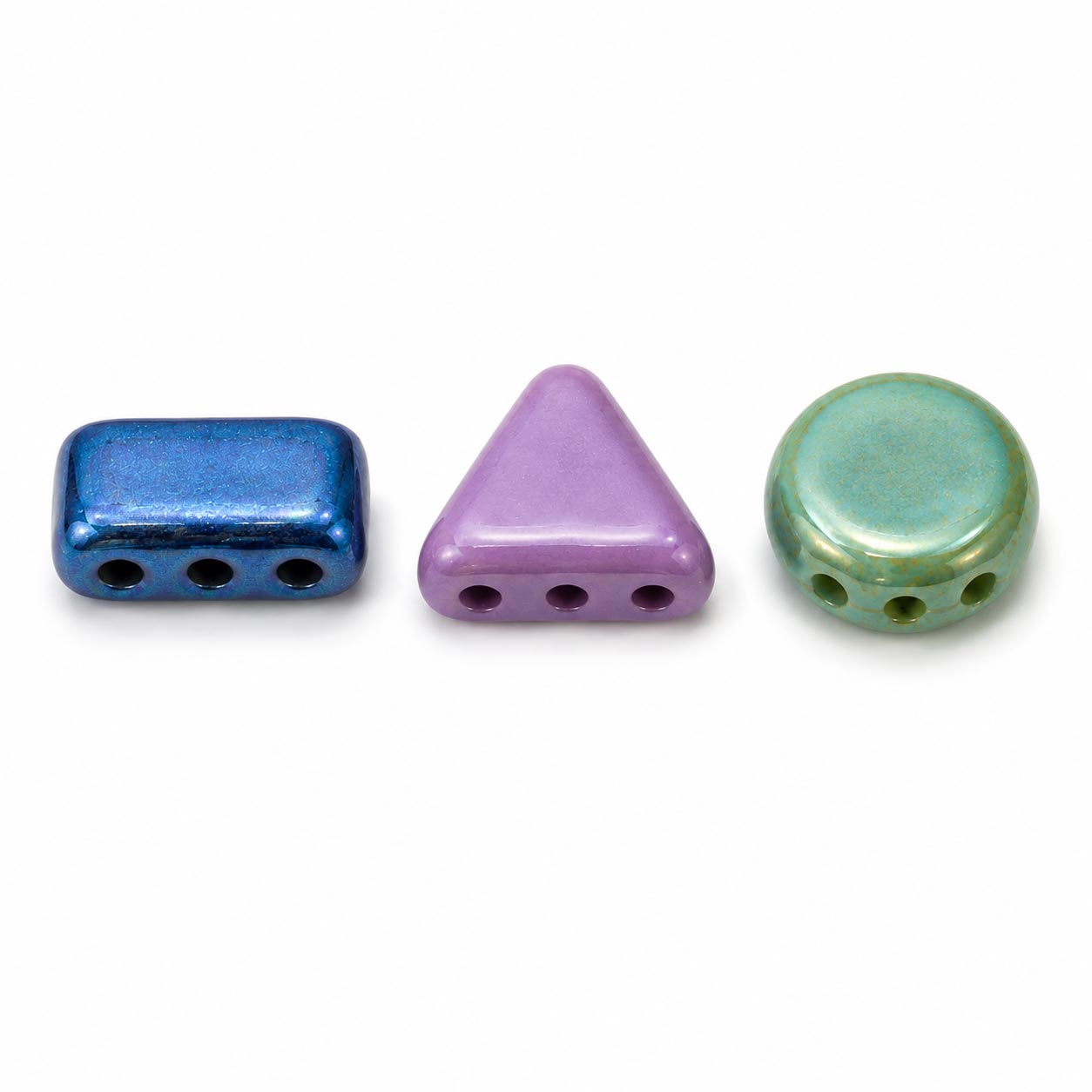
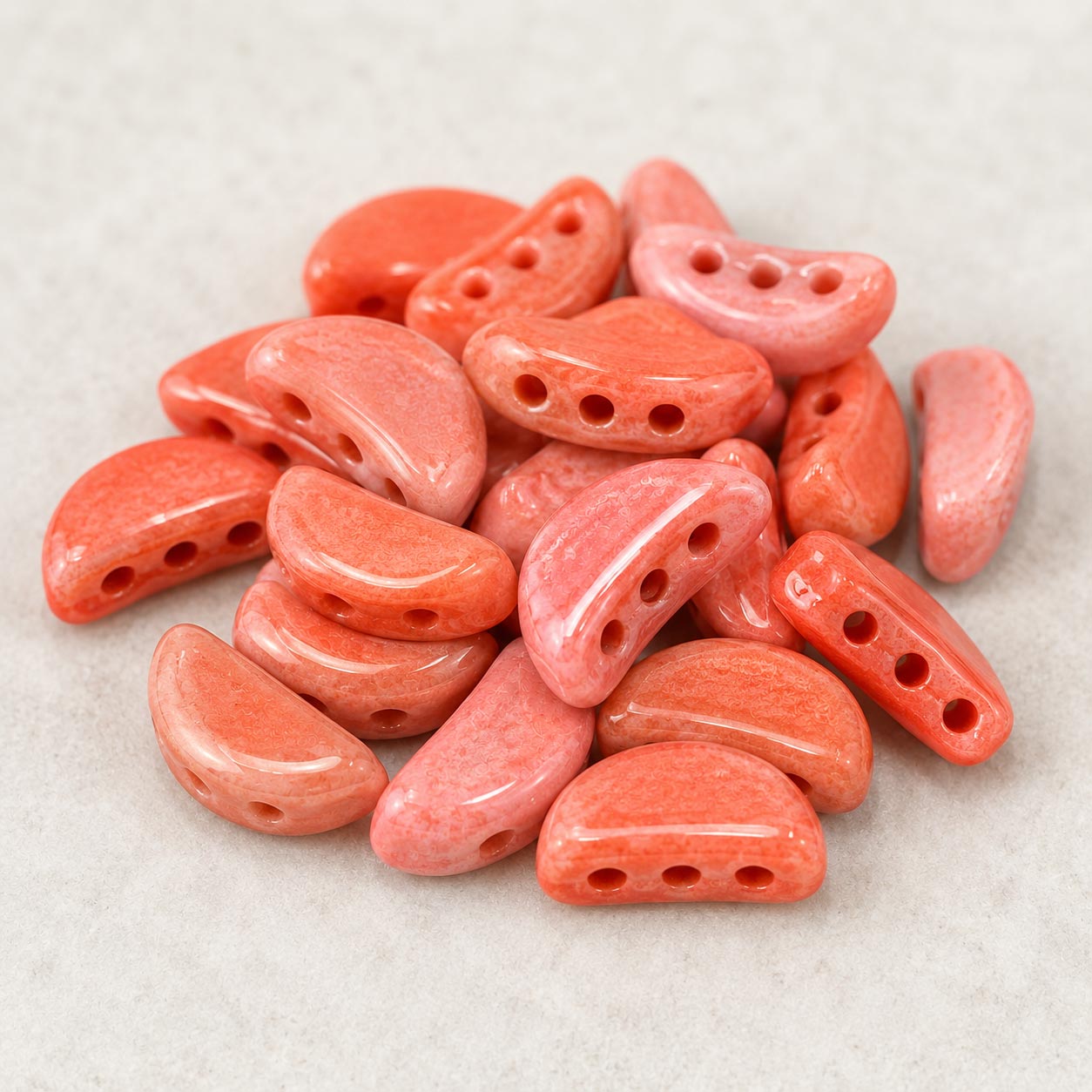
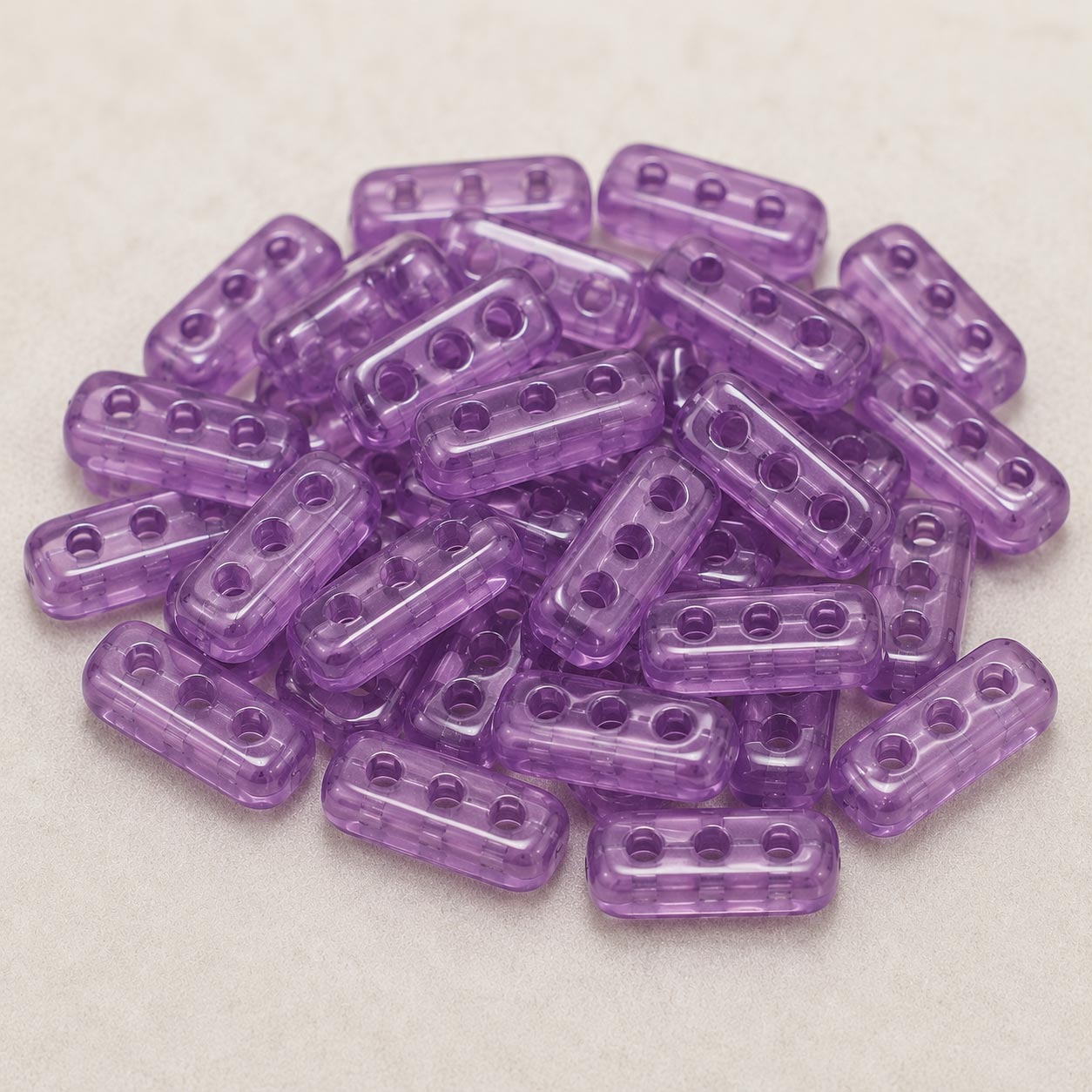
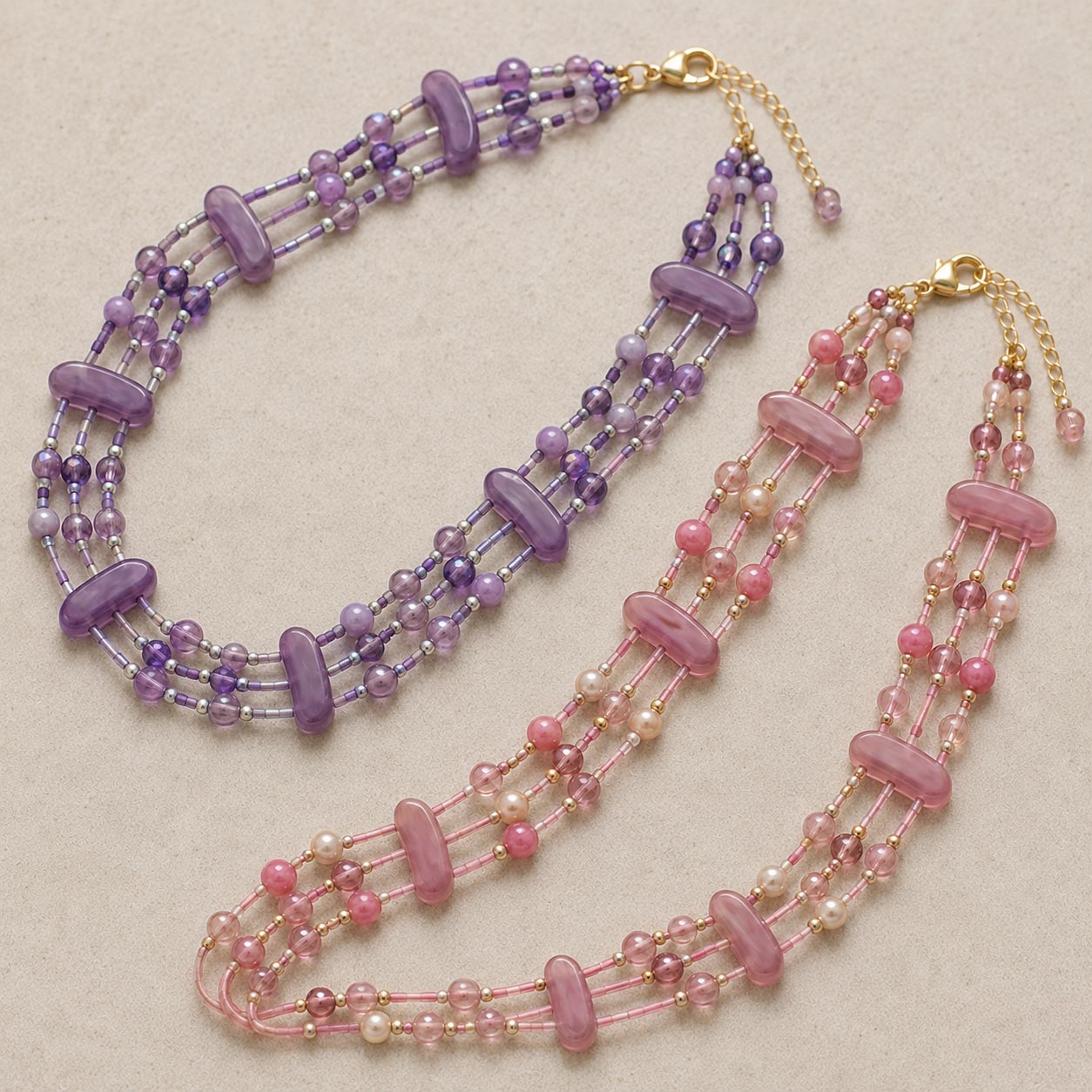
Shape: 3-hole beads are manufactured in a variety of shapes, including bars, rectangles, triangles, discs, rounds, and specialty geometric designs. Their defining characteristic is not their shape but the presence of three parallel holes that allow multiple strands or rows of thread to pass through the bead.
Materials, Sizes, and Finishes: Most 3-hole beads are made from pressed glass, although some varieties are produced from acrylic, resin, ceramic, or other specialty materials. They are available in a range of sizes depending on the style and manufacturer, with many measuring between approximately 4 mm and 15 mm. Finishes include transparent, translucent, opaque, metallic, matte, luster, pearlized, frosted, Picasso, iridescent, and Aurora Borealis (AB), among many others.
Description: 3-hole beads are specialty beads designed with three separate holes running through the bead, allowing crafters to create intricate patterns and layered designs that would be difficult or impossible with traditional single-hole beads. The multiple holes help maintain even spacing and alignment while adding stability and structure to beadwork.
These beads are especially popular in bead weaving and jewelry making, where they can be incorporated into bracelets, necklaces, earrings, decorative embellishments, and artistic beadwork. By passing thread or wire through different combinations of holes, designers can create dimensional effects, lattice patterns, geometric motifs, and complex woven structures with relatively simple techniques.
Many 3-hole beads are engineered to work alongside seed beads, two-hole beads, and other specialty components, giving designers tremendous flexibility when developing original patterns. Their consistent sizing and carefully positioned holes make them ideal for precision bead weaving and repetitive designs.
Fun Facts: Unlike traditional beads that primarily serve as decorative elements on a single strand, 3-hole beads can also function as structural components within a design. Their multiple holes help distribute tension across several threads, often resulting in stronger and more stable finished pieces. Depending on the pattern, some holes may even be left unused to create unique visual effects.
History and Origin: Multi-hole beads are a relatively modern innovation in the bead industry. While traditional single-hole beads have existed for thousands of years, advances in glass pressing and precision manufacturing during the late twentieth and early twenty-first centuries led to the development of specialty bead shapes with multiple holes. These designs quickly gained popularity among jewelry designers and bead artists looking for new creative possibilities and more efficient construction methods.
Shape: AB is not a bead shape but rather a specialty finish that can be applied to many different bead styles, including round beads, faceted beads, pony beads, seed beads, crystals, bugle beads, barrel beads, and countless other shapes.
Materials, Sizes, and Finishes: The Aurora Borealis finish can be applied to beads made from a variety of materials including glass, crystal, acrylic, resin, and plastic. Because AB refers to a surface coating rather than a bead style, it is available in virtually every size and shape produced by manufacturers. The finish may be found on transparent, translucent, opaque, metallic, pearlized, or faceted beads.
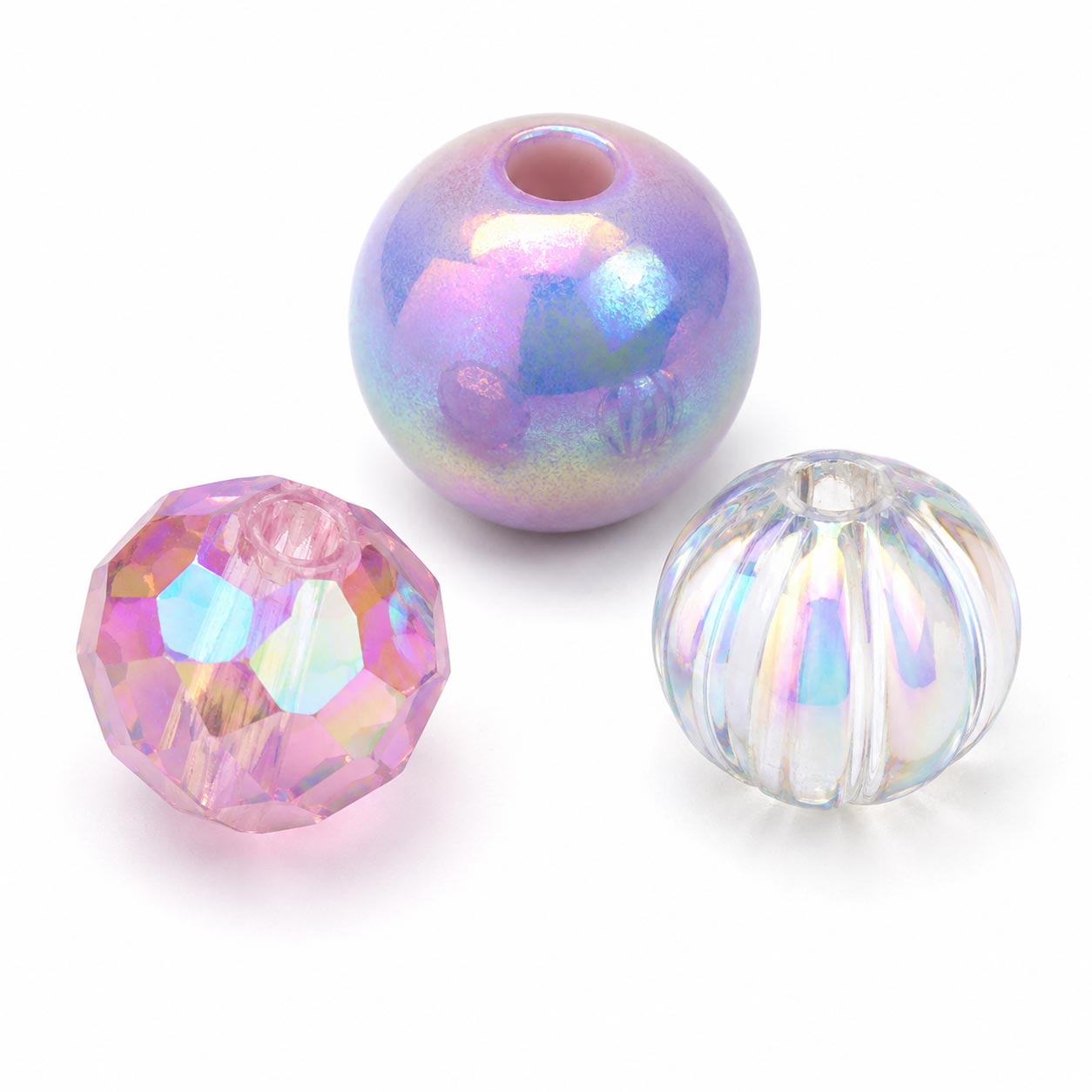
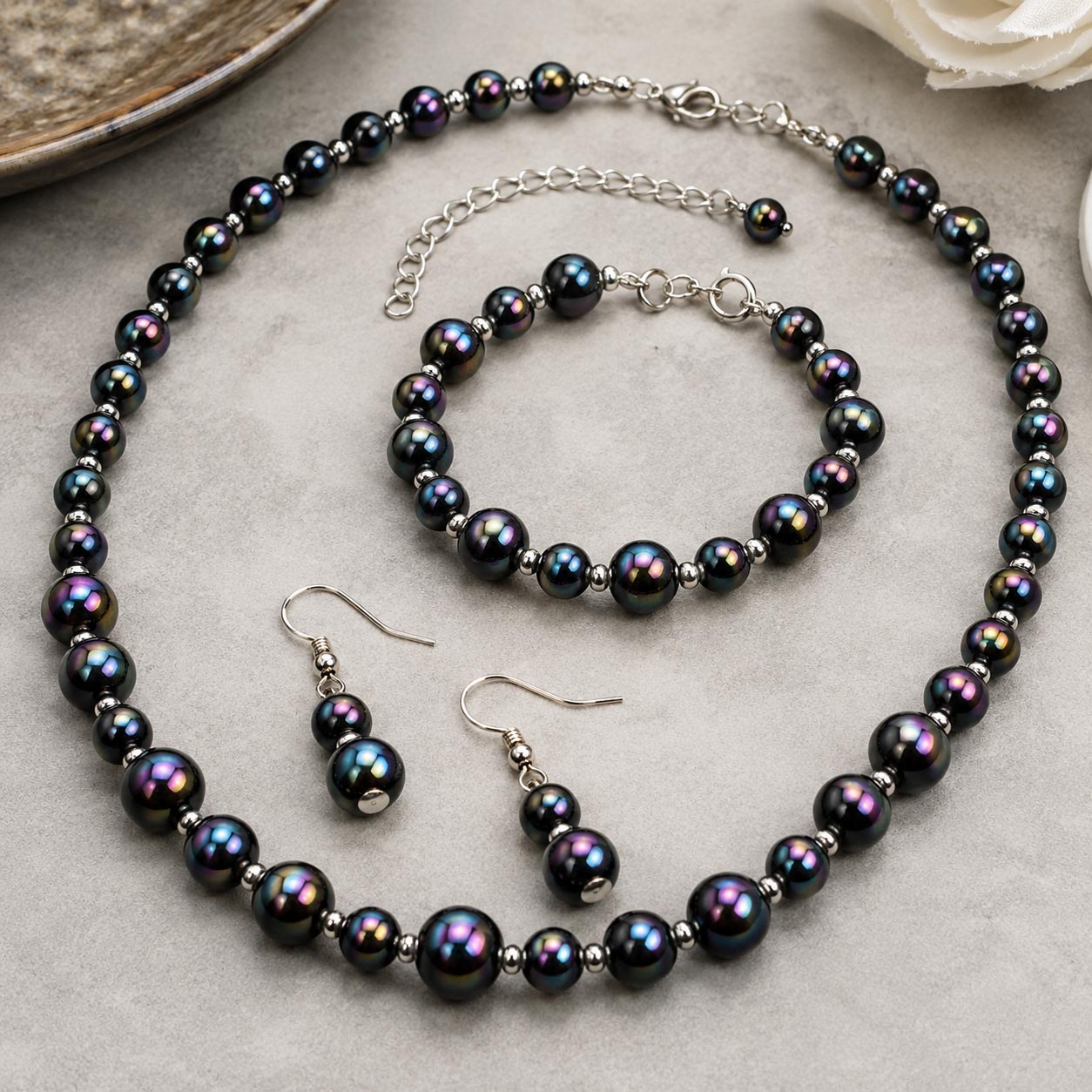
Description: AB stands for Aurora Borealis, a decorative iridescent coating that produces a shimmering rainbow effect when light strikes the bead's surface. The finish reflects subtle flashes of pink, blue, gold, green, purple, and other colors that appear to change depending on the viewing angle and lighting conditions. Unlike a bead color, the AB coating enhances the underlying bead without completely hiding it, giving the bead added depth and brilliance.
The Aurora Borealis finish is one of the most popular specialty coatings used in the beading industry because it adds sparkle and visual interest without altering the basic shape of the bead. It is especially attractive on transparent and translucent beads, where the light can pass through the material while also reflecting from the iridescent surface.
AB beads are commonly used in jewelry making, ornaments, suncatchers, keychains, beaded animals, holiday decorations, wedding accessories, floral arrangements, decorative crafts, and home décor projects. Many crafters use AB beads as accent beads to add flashes of color, while others create entire projects using the finish for maximum sparkle.
Fun Facts: Although many people refer to AB as a type of bead, it is actually a finish rather than a bead style or material. The same Aurora Borealis coating can be applied to everything from tiny seed beads to large pony beads and sparkling faceted crystals. Depending on the manufacturer, the coating may cover the entire bead or only part of its surface, producing different visual effects.

The Aurora Borealis finish was introduced in the 1950s through a collaboration between the crystal manufacturer Swarovski and French fashion designer Christian Dior. Inspired by the colorful display of the Northern Lights, the coating was developed to create crystals with an iridescent rainbow appearance. Its popularity quickly spread throughout the jewelry and craft industries, and today similar AB finishes are produced by manufacturers around the world on a wide variety of bead materials.
Information coming soon.
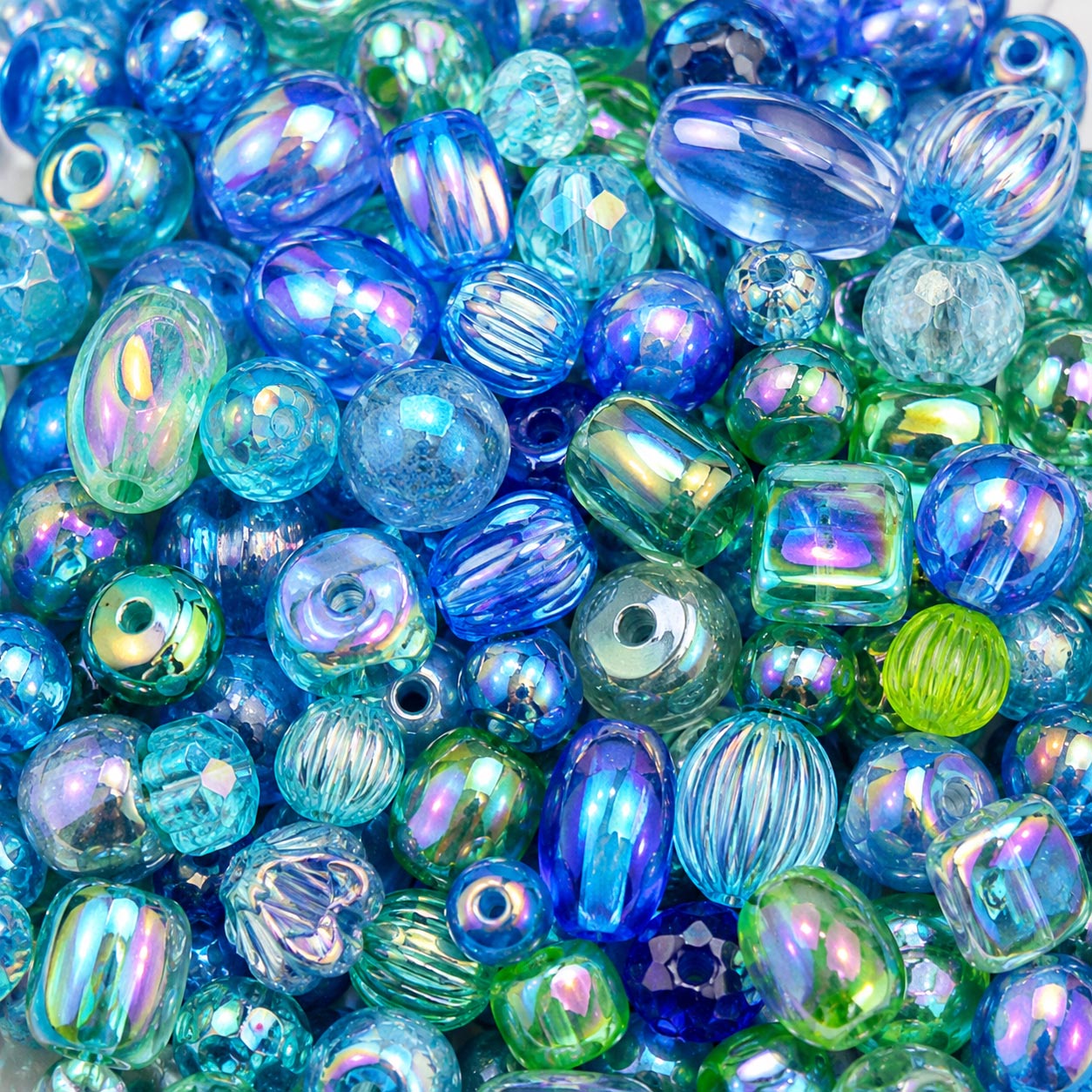
Acrylic beads are among the most popular and versatile beads used in crafts, jewelry making, and decorative projects. Manufactured from acrylic plastic, these beads are lightweight, durable, and available in an enormous variety of colors, shapes, sizes, and finishes. Their affordability and versatility have made them a favorite choice for both beginning and experienced crafters.
One of the greatest advantages of acrylic beads is their ability to imitate the appearance of other materials while remaining significantly lighter in weight. Acrylic beads can be manufactured to resemble glass, crystal, pearls, gemstones, metal, ceramic, and even natural materials. This allows designers to achieve a desired look without the added weight or expense that some materials may require.
Acrylic beads are produced in countless shapes including round, faceted, barrel, pony, heart, star, flower, cube, teardrop, oval, and novelty designs. They are available in finishes such as opaque, transparent, translucent, pearlized, metallic, frosted, glitter, iridescent, Aurora Borealis (AB), and glow-in-the-dark. This wide selection makes acrylic beads suitable for virtually every type of craft and beading project.
Because acrylic is lightweight and resistant to breakage, acrylic beads are especially popular for children's crafts, camp activities, keychains, ornaments, beaded animals, jewelry, home décor, holiday decorations, and educational projects. Larger acrylic beads can be used comfortably in necklaces and decorative hangings where the weight of glass or stone beads might become a concern.
Acrylic beads are often chosen for projects that require bright colors, durability, and affordability. Their smooth surfaces and consistent manufacturing make them easy to string on a variety of materials including cord, elastic, ribbon, wire, thread, and plastic lacing. Many acrylic beads also feature larger holes than comparable glass beads, making them easier to use for beginner crafters and group activities.
While acrylic beads may not have the weight or brilliance of crystal or glass beads, they offer exceptional versatility and value. Their ability to be molded into virtually any shape and produced in an endless range of colors has made them one of the most widely used bead materials in the world.
From simple children's crafts to elaborate decorative projects, acrylic beads continue to be appreciated for their colorful appearance, lightweight construction, durability, and creative possibilities. Their combination of affordability and variety ensures they remain a staple in craft rooms, classrooms, and jewelry studios alike.
Information coming soon.
Alphabet beads are beads printed, engraved, molded, or stamped with letters. They are commonly used to spell names, initials, words, team names, short messages, and inspirational phrases. Alphabet beads are often found in round, cube, oval, and flat disc shapes.
These beads are popular for bracelets, necklaces, keychains, backpack charms, classroom projects, party crafts, and personalized gifts. They are usually made from plastic, acrylic, wood, or metal and may feature black lettering, colored lettering, raised letters, or engraved designs.
Information coming soon.
Baroque beads are beads characterized by their irregular, asymmetrical shapes rather than the uniform shapes commonly associated with round, oval, or faceted beads. The term *baroque* comes from a word historically used to describe objects with unusual, elaborate, or imperfect forms. In the world of beads and jewelry making, baroque beads are valued for their unique appearance and the individuality they bring to a design.
Baroque beads are most commonly associated with pearls. A baroque pearl is a pearl that forms in an irregular shape rather than a perfectly round one. Because no two baroque pearls are exactly alike, they are often prized for their distinctive beauty and organic appearance. Today, the term baroque bead is also used to describe beads made from glass, acrylic, resin, gemstone, shell, ceramic, and other materials that intentionally feature uneven, freeform, or naturally inspired shapes.
Unlike beads manufactured to exact dimensions, baroque beads often vary in size, contour, texture, and profile. Some may be gently irregular with subtle variations, while others may have dramatic curves, ridges, twists, or sculpted surfaces. These natural-looking imperfections can add character, movement, and visual interest to a project that would be difficult to achieve with perfectly symmetrical beads.
Baroque beads are commonly used as focal elements in jewelry designs where their unique shape can be highlighted. They are popular in necklaces, bracelets, earrings, pendants, and decorative accessories. Their organic appearance also makes them well suited for beach-themed jewelry, nature-inspired designs, artistic beadwork, and projects that emphasize individuality and craftsmanship.
Baroque beads may be found in a wide variety of finishes including polished, frosted, metallic, pearlized, iridescent, transparent, translucent, and opaque styles. Depending on the material, they may exhibit smooth surfaces, natural textures, carved details, or faceted areas that reflect light in different ways.
Because each baroque bead has its own unique form, designers often embrace their variations rather than attempting to create perfectly symmetrical arrangements. This distinctive quality has made baroque beads a favorite among jewelry makers and crafters seeking a more artistic, natural, and one-of-a-kind appearance in their work.
Whether made from pearl, glass, gemstone, shell, acrylic, or other materials, baroque beads offer an appealing alternative to traditional bead shapes and continue to be appreciated for their individuality, character, and timeless beauty.
Barrel beads are a popular bead shape characterized by their rounded cylindrical form, which resembles a small barrel or drum. Most barrel beads feature a wider center section that gradually tapers toward each end, creating a smooth, balanced appearance. This distinctive shape allows barrel beads to fit comfortably alongside other beads while adding visual interest and dimension to a design.
A hole typically runs lengthwise through the center of the bead, making barrel beads easy to string on cord, wire, thread, elastic, ribbon, and other beading materials. Their shape allows them to slide smoothly during stringing while providing a larger visual presence than many simple round beads. Depending on the size and material, barrel beads may be used as primary design elements, spacer beads, or focal accents within a project.
Barrel beads are manufactured from a wide variety of materials. Glass barrel beads are often valued for their color, shine, and decorative finishes. Wood barrel beads provide a natural, rustic appearance and are commonly used in macramé, jewelry, and home décor projects. Plastic and acrylic barrel beads are lightweight, affordable, and available in countless colors and finishes, making them popular for crafts, keychains, ornaments, and children's projects. Barrel beads may also be made from metal, ceramic, bone, shell, gemstone, resin, and other specialty materials.
Because of their versatile shape, barrel beads are used in a wide range of projects including jewelry, keychains, beaded decorations, ornaments, bookmarks, home décor, and decorative accessories. They may be smooth, faceted, carved, painted, engraved, pearlized, metallic, transparent, translucent, opaque, or iridescent depending on the material and manufacturing process.
Barrel beads are sometimes confused with pony beads because many pony beads share a similar barrel-like profile. However, the term "barrel bead" refers to the bead's shape rather than a specific material, size, or style. As a result, barrel beads may range from small jewelry beads to large decorative craft beads and can be found in virtually every area of beading and jewelry making.
Their simple yet attractive shape, ease of stringing, and availability in countless materials and finishes have made barrel beads a longtime favorite among crafters, jewelry makers, and bead artists around the world.
Information coming soon.
Berry beads are small, rounded beads that resemble the shape of a berry or tiny fruit. They are typically slightly larger and more rounded than traditional seed beads, featuring a smooth surface and a hole running through the center. Their soft, organic shape adds texture and dimension to beadwork while maintaining a natural and pleasing appearance.
Most berry beads are made from glass and are manufactured with a high degree of consistency, making them suitable for both simple stringing projects and more advanced bead-weaving techniques. Despite their name, berry beads are not intended to represent a specific type of fruit. Rather, the name refers to their plump, rounded profile, which resembles small berries clustered together in nature.
Berry beads are often used in bead weaving, embroidery, fringe work, and jewelry making. Their rounded shape allows them to nest closely together, creating interesting textures and patterns that can be difficult to achieve with standard seed beads alone. Designers frequently use berry beads to add visual softness, raised surfaces, and decorative accents to bracelets, necklaces, earrings, and ornamental beadwork.
Available in a wide range of colors and finishes, berry beads may be transparent, translucent, opaque, metallic, iridescent, pearlized, frosted, or coated with specialty finishes. Their smooth contours reflect light differently than faceted beads, creating a softer and more subtle appearance.
Because of their unique shape, berry beads are commonly combined with seed beads, Delica beads, crystals, and other specialty beads in woven designs. They can be used as accent beads, texture beads, or focal elements depending on the project. Their versatility and pleasing shape have made them a popular choice among bead artists seeking to add depth and organic character to their creations.
Whether incorporated into intricate bead-weaving patterns or used as decorative accents in jewelry, berry beads offer an attractive combination of texture, consistency, and visual appeal that continues to make them a favorite among contemporary beaders.
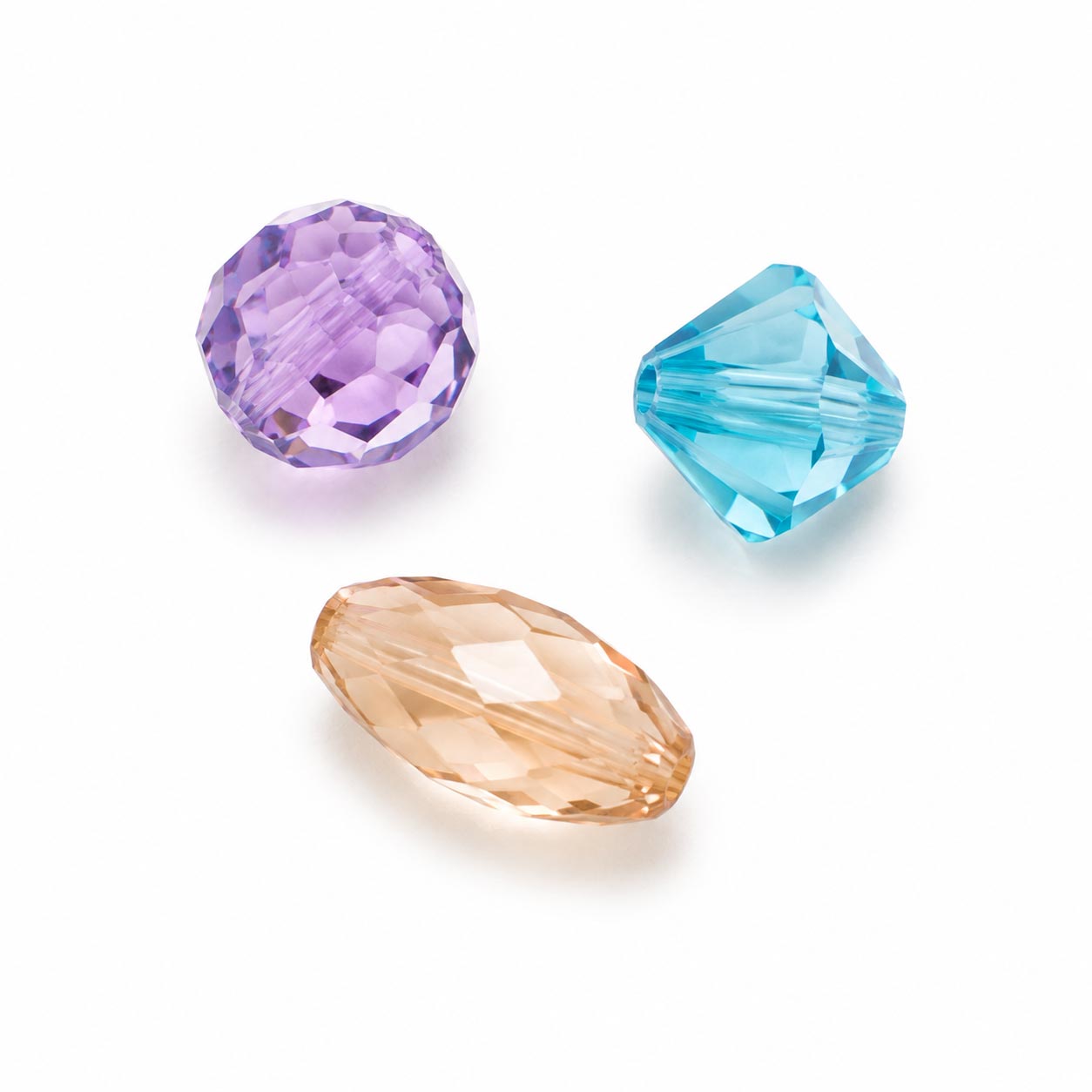
Bicone beads are beads shaped like two cones joined together at their widest points, creating a symmetrical form that tapers toward both ends. This distinctive shape combines the visual appeal of a faceted bead with a balanced profile that works well in a wide variety of jewelry and decorative projects. The center of the bead is its widest point, while both ends gradually narrow toward the stringing hole, giving bicone beads their characteristic diamond-like silhouette.
Bicone beads are commonly manufactured from glass and crystal, although they can also be found in acrylic, plastic, resin, metal, gemstone, and other materials. Many bicone beads feature multiple facets that reflect and refract light, producing sparkle and brilliance that make them especially popular in jewelry making. Crystal bicones are particularly prized for their ability to catch light and create dazzling visual effects.
The hole in a bicone bead typically runs lengthwise from one pointed end to the other, allowing the bead to sit neatly within a design. Because the bead tapers at both ends, bicones often fit together smoothly with other bead shapes and can create elegant transitions between larger focal beads and smaller accent beads.
Bicone beads are widely used in necklaces, bracelets, earrings, ornaments, bridal accessories, bead weaving, and decorative embellishments. Their shape allows them to add sparkle without excessive bulk, making them suitable for both delicate and elaborate designs. They are frequently used as spacer beads, accent beads, or primary design elements depending on the size and style of the project.
Available in countless colors, sizes, and finishes, bicone beads may be transparent, translucent, opaque, frosted, metallic, iridescent, Aurora Borealis (AB), pearlized, or coated with specialty finishes. Faceted bicones are among the most popular choices for projects that require brilliance and light reflection, while smooth bicones offer a more subtle and contemporary appearance.
Because of their versatility, symmetry, and ability to reflect light, bicone beads have become a staple in both traditional and modern beadwork. Whether used in elegant jewelry, decorative ornaments, or intricate bead-weaving projects, bicone beads remain one of the most recognizable and widely used bead shapes in the crafting and jewelry-making world.
Information coming soon.
Bone beads are beads made from animal bone that has been cleaned, shaped, drilled, and polished for use in jewelry, crafts, and decorative projects. They are among the oldest bead types known to humanity, with examples dating back thousands of years. Throughout history, bone beads have been used for personal adornment, trade, ceremonial objects, and decorative artwork by cultures around the world.
The natural appearance of bone gives these beads a distinctive organic character that differs from glass, plastic, metal, or gemstone beads. Most bone beads range in color from ivory and cream to light tan and brown, although they may also be dyed, painted, carved, stained, or engraved to create a wide variety of decorative effects. Because bone is a natural material, slight variations in color, texture, and grain are common and contribute to the uniqueness of each bead.
Bone beads are available in many shapes and sizes, including rounds, barrels, tubes, discs, spacers, carved figures, and specialty shapes. Some are polished smooth for a refined appearance, while others feature hand-carved patterns, geometric designs, tribal motifs, or decorative engravings. These artistic details have made bone beads particularly popular in traditional, rustic, and artisan jewelry designs.
Due to their durability and relatively light weight, bone beads are commonly used in necklaces, bracelets, earrings, keychains, decorative accessories, and mixed-media craft projects. They are often combined with wood, shell, leather, metal, gemstone, and glass beads to create designs that emphasize natural materials and handcrafted character.
Bone beads are especially popular in ethnic, tribal, western, bohemian, and nature-inspired jewelry styles. Their warm appearance and natural texture provide visual contrast when paired with polished stones, shiny metals, or brightly colored glass beads. Many designers appreciate the fact that bone beads can add both texture and historical character to a piece without overwhelming the overall design.
Because bone is a natural material, individual beads may vary slightly in shape, color, and surface texture. These variations are generally considered desirable and are often viewed as part of the bead's appeal. Rather than striving for perfect uniformity, many artisans embrace these subtle differences as evidence of the material's natural origin.
With their rich history, distinctive appearance, and connection to traditional craftsmanship, bone beads continue to be valued by jewelry makers, collectors, and crafters seeking natural materials that add warmth, character, and authenticity to their designs.
Brick beads are specialty beads shaped much like a miniature brick, featuring a rectangular profile with flat sides and slightly rounded edges. Their distinctive shape allows them to fit closely together, creating clean lines and geometric patterns that are difficult to achieve with traditional round beads. Because of their flat surfaces and uniform dimensions, brick beads are especially popular in bead-weaving designs and contemporary jewelry projects.
Many brick beads are manufactured from glass, although versions made from acrylic, resin, ceramic, and other materials can also be found. They are available in a wide variety of colors, finishes, and sizes, allowing designers to create everything from subtle monochromatic designs to bold, colorful patterns. Depending on the manufacturer, brick beads may have one or more holes running through the bead, providing additional design possibilities and structural stability in woven beadwork.
The flat surfaces of brick beads allow them to stack neatly alongside one another, producing a tiled or mosaic-like appearance. This characteristic makes them particularly useful for creating geometric patterns, intricate bead weaving, decorative embellishments, bracelets, necklaces, earrings, and contemporary bead art. Their shape also enables designers to create smooth surfaces and crisp edges that are often difficult to achieve with rounded beads.
Brick beads are available in transparent, translucent, opaque, metallic, iridescent, frosted, pearlized, and specialty finishes. Some styles are precision manufactured to maintain highly consistent sizing, making them especially desirable for projects that require accurate alignment and uniform spacing.
Because of their modern appearance and versatility, brick beads have become a favorite among bead artists looking to add structure, texture, and geometric interest to their work. Whether used in simple stringing projects or complex bead-weaving designs, brick beads provide a distinctive architectural quality that sets them apart from many traditional bead shapes.
Their combination of clean lines, uniform shape, and wide range of available finishes has made brick beads an increasingly popular choice for both jewelry makers and decorative bead artists seeking a contemporary look in their creations.
Briolette beads are elegant, elongated beads that are typically shaped like a teardrop or pear. They are most often faceted, allowing them to reflect light from multiple angles and create exceptional sparkle. Unlike many other bead types that are drilled through the center from end to end, briolette beads are commonly drilled near the top of the bead so they can hang freely and showcase their distinctive shape.
The briolette cut originated in the gemstone industry and has been used for centuries to enhance the beauty of precious and semi-precious stones. Today, the term briolette is used to describe both the shape and cutting style of beads that feature a graceful drop-like form with numerous polished facets. The result is a bead that combines movement, brilliance, and sophistication.
Briolette beads are manufactured from a variety of materials including crystal, glass, gemstone, acrylic, resin, and even shell. Crystal and glass briolettes are especially popular because their faceted surfaces produce exceptional sparkle and light reflection. Gemstone briolettes showcase the natural beauty of stones while adding additional brilliance through faceting.
Because of their elegant shape, briolette beads are frequently used as focal elements in jewelry designs. They are particularly popular in earrings, pendants, necklaces, bridal jewelry, and decorative accessories. Their hanging design allows them to catch light and move freely, creating a dynamic appearance that is difficult to achieve with more traditional bead shapes.
Briolette beads are available in many colors, sizes, and finishes. They may be transparent, translucent, opaque, frosted, metallic, iridescent, Aurora Borealis (AB), or naturally colored depending on the material. While most briolettes feature faceted surfaces, some styles are smooth and polished, offering a softer and more understated appearance.
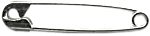
The elongated shape of briolette beads makes them ideal for designs that emphasize movement and elegance. Whether suspended from a delicate earring, incorporated into an elaborate necklace, or used as a decorative accent, briolette beads draw attention through their graceful form and brilliant light-catching qualities.
Their combination of beauty, sparkle, and timeless appeal has made briolette beads a favorite among jewelry makers and bead artists seeking to add sophistication and visual interest to their creations.
Information coming soon.
Bugle beads are long, narrow tube-shaped beads that are distinguished by their cylindrical form and straight sides. Unlike round seed beads, bugle beads have an elongated shape that allows them to create lines, texture, and movement within a design. Their unique appearance makes them a popular choice for jewelry making, bead embroidery, decorative trims, ornaments, and a wide variety of craft projects.
Most bugle beads are made from glass, although acrylic, plastic, metal, and specialty materials are also available. They are manufactured in a range of lengths, from very short tubes that closely resemble elongated seed beads to much longer styles that can become a prominent design feature. The hole runs lengthwise through the center of the bead, allowing it to be strung, woven, stitched, or embroidered into a project.
Bugle beads are available in countless colors and finishes, including transparent, translucent, opaque, metallic, iridescent, pearlized, frosted, lined, and Aurora Borealis (AB) finishes. Their smooth surfaces and elongated shape reflect light differently than round beads, creating visual interest and a distinctive texture within beadwork.
One of the most common uses for bugle beads is in bead embroidery and decorative embellishment. Their straight shape allows designers to create geometric patterns, borders, rays, starbursts, fringe, and linear accents that would be difficult to achieve using round beads alone. They are also widely used in jewelry, holiday ornaments, evening wear, costumes, dance apparel, handbags, and decorative home accents.
Bugle beads are frequently combined with seed beads in woven and embroidered designs. The seed beads help provide flexibility and spacing, while the bugle beads add structure and length. This combination has been used for decades in both traditional and contemporary beadwork.
Because bugle beads have elongated edges, some glass varieties may have sharper ends than round beads. For this reason, many beaders use high-quality thread and proper tension when incorporating bugle beads into woven projects. Modern manufacturing techniques have improved the finish on many bugle beads, making them more beadwork-friendly than some earlier versions.
Available in numerous sizes, colors, and finishes, bugle beads remain a favorite among jewelry makers, bead artists, and crafters who want to add texture, dimension, sparkle, and linear design elements to their creations. Their distinctive tubular shape continues to make them one of the most recognizable and versatile bead styles in the world of beading.
Information coming soon.
Cat eye beads, also called Cateye and Cat's Eye beads, are specialty beads known for a unique optical effect that creates a narrow band of reflected light across the surface of the bead. This bright, moving line resembles the appearance of a cat's eye, giving the beads their distinctive name. As the bead is rotated or viewed from different angles, the band of light appears to shift across the surface, creating an attractive shimmering effect.
The cat eye effect, known as chatoyancy, occurs when light reflects from parallel fibers or internal structures within the material. While natural gemstones such as chrysoberyl, quartz, and tourmaline can exhibit this phenomenon, most cat eye beads used in jewelry and crafts are manufactured from fiber-optic glass. This material is engineered to produce a strong and consistent cat eye effect throughout the bead.
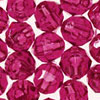
Cat eye beads are typically smooth and highly polished, allowing the reflective band to be clearly visible. They are most commonly produced in round, oval, rice, rondelle, heart, and specialty shapes. Their smooth surfaces and luminous appearance make them popular in both contemporary and traditional jewelry designs.
Available in a wide variety of colors, cat eye beads can be found in shades ranging from soft pastels and natural earth tones to bright jewel colors and vivid fashion hues. Unlike many beads that rely on sparkle from faceted surfaces, cat eye beads create visual interest through their moving band of light, giving them a softer and more elegant appearance.
Cat eye beads are frequently used in necklaces, bracelets, earrings, pendants, keychains, decorative accessories, and beaded crafts. They are often combined with metal findings, gemstones, pearls, crystal beads, and glass beads to create designs that emphasize color and light. Because the cat eye effect is most visible on larger beads, they are often used as focal beads within a design.
Many beginning beaders mistakenly assume cat eye beads are made from gemstone cat's eye material. While natural chatoyant gemstones do exist, the majority of cat eye beads found in craft stores and jewelry supplies are manufactured fiber-optic glass beads designed to mimic the appearance of natural cat's eye gemstones.
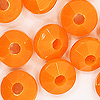
With their smooth finish, vibrant colors, and distinctive band of reflected light, cat eye beads remain a popular choice for jewelry makers and crafters seeking a bead that offers beauty, movement, and visual interest without relying on heavy faceting or elaborate decoration.
Information coming soon.
Cathedral beads are decorative faceted beads that feature a distinctive combination of molded facets and contrasting color accents. Traditionally, cathedral beads are made from glass and are recognized by their faceted surfaces, which are highlighted by a second color that fills grooves, recesses, or decorative details around the bead. This two-tone appearance creates depth and visual interest, giving cathedral beads a unique look that differs from ordinary faceted beads.
The name "cathedral bead" is believed to have originated from the bead's resemblance to the stained-glass windows and ornate architectural details found in European cathedrals. The contrasting colors and faceted surfaces often create an effect reminiscent of decorative leaded glass, making these beads particularly attractive in jewelry and ornamental designs.
Most cathedral beads are manufactured from pressed glass. After the bead is molded and faceted, a contrasting finish is applied to accentuate the recessed areas. Common color combinations include gold over transparent colors, silver over jewel tones, black over crystal, and other combinations designed to emphasize the bead's decorative features. The result is a bead with greater visual complexity than a standard faceted bead.
Cathedral beads are available in a wide range of sizes, colors, and finishes. They are commonly found in round, oval, and elongated shapes, although specialty forms are also available. Transparent and translucent glass varieties are especially popular because they allow light to pass through the bead while highlighting the decorative color accents.
Because of their elegant appearance, cathedral beads are frequently used in necklaces, bracelets, earrings, rosaries, ornaments, and vintage-inspired jewelry designs. They are often incorporated into projects where the bead itself serves as a focal point rather than simply functioning as a spacer or accent. Their distinctive appearance makes them especially popular in traditional, Victorian, and heirloom-style jewelry.
Cathedral beads are sometimes confused with ordinary faceted glass beads, but their defining characteristic is the presence of contrasting decorative accents that highlight the molded details of the bead. This additional finishing step creates the rich, dimensional appearance that cathedral beads are known for.
With their combination of sparkle, color, and decorative detail, cathedral beads have remained popular with jewelry makers and collectors for generations. Their timeless beauty and distinctive construction continue to make them one of the most recognizable specialty glass bead styles available.
Information coming soon.
Ceramic beads are beads made from clay that has been shaped, dried, and fired at high temperatures to create a durable finished product. They encompass a broad category of bead types that includes earthenware, stoneware, and porcelain. While all porcelain beads are ceramic beads, not all ceramic beads are porcelain. The type of clay used, firing temperature, and manufacturing process determine the final characteristics of the bead. They are among the oldest bead types known to humanity, with examples appearing in cultures around the world for thousands of years. Ceramic beads are valued for their artistic appearance, handcrafted character, and the wide variety of shapes, colors, and finishes that can be achieved during the manufacturing process.
Most ceramic beads begin as natural clay that is molded, carved, pressed, or formed into a desired shape. After drying, the beads are fired in a kiln to harden the clay. Many ceramic beads are then coated with decorative glazes and fired a second time to create colorful, durable surfaces. Depending on the materials and techniques used, ceramic beads may have glossy, matte, crackled, textured, speckled, metallic, or hand-painted finishes.
Ceramic beads are available in an enormous variety of shapes and sizes, including rounds, barrels, tubes, discs, hearts, flowers, animals, and freeform artistic designs. Ceramic beads are also available in a wide variety of finishes ranging from rustic and textured to smooth and highly polished. Depending on the clay body and glaze, ceramic beads may appear earthy and handcrafted or refined and decorative. This versatility has made ceramic beads popular in artisan jewelry, decorative crafts, ornaments, and mixed-media designs. Because they are often handmade or produced in small batches, slight variations in color, shape, and texture are common and are generally considered part of their charm.
The rich colors and decorative glazes used on ceramic beads make them especially popular in artisan jewelry, bohemian designs, ethnic jewelry, decorative crafts, ornaments, and mixed-media projects. Their handmade appearance allows designers to create pieces with a more natural and artistic character than many mass-produced bead materials.
Ceramic beads are frequently combined with wood, metal, leather, gemstone, shell, and glass beads to create designs that emphasize texture and contrast. Their substantial feel and unique surface treatments often allow them to serve as focal beads within a project. Larger ceramic beads are particularly effective in necklaces, bracelets, pendants, and decorative home décor items.
Unlike plastic or acrylic beads, ceramic beads have a pleasing weight and solidity that many jewelry makers appreciate. However, because they are made from fired clay, they can be more fragile than some other bead materials and may crack or break if dropped onto a hard surface.
Today, ceramic beads range from simple handcrafted clay beads to highly detailed works of art featuring intricate glazes, carved patterns, painted designs, and sculptural forms. Their combination of creativity, history, and craftsmanship continues to make ceramic beads a favorite among artists, collectors, jewelry makers, and crafters seeking something distinctive and unique.
Information coming soon.
Charm beads are decorative beads designed to add personality, theme, or meaning to a project. They may include small shapes, symbols, animals, flowers, hearts, letters, holiday designs, or objects. Some charm beads are strung like regular beads, while others hang from a loop like a traditional charm.
Charm beads are popular in bracelets, necklaces, keychains, zipper pulls, bookmarks, bag charms, and personalized gifts. They may be made from metal, acrylic, glass, enamel, wood, clay, or plastic.
Information coming soon.
Crow beads are large, rounded beads with a center hole. They are similar in appearance to pony beads but are often associated with glass trade beads and traditional decorative beadwork. Crow beads may be made from glass, plastic, or other materials, depending on the style and manufacturer.
Because of their larger size and bold appearance, crow beads are useful for necklaces, regalia, decorative crafts, keychains, and projects where a larger bead is desired. In many simple craft projects, crow beads and pony beads can sometimes be substituted for one another, although their size, weight, and material may differ.
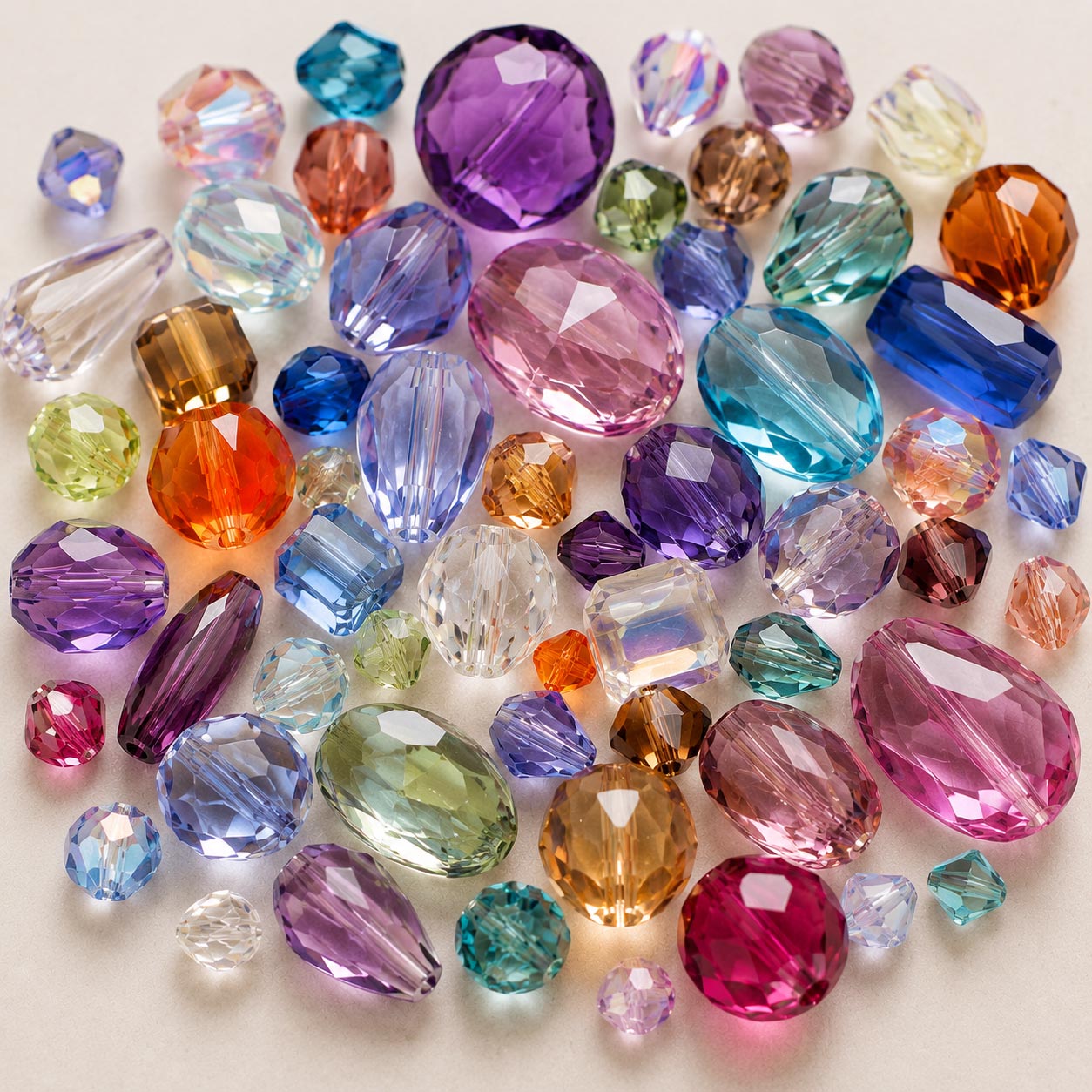
Crystal beads are highly reflective beads made from glass or crystal-like material, often cut with facets to increase sparkle. They are known for their brilliance and are frequently used when a project needs elegance, shimmer, or a formal appearance.
Crystal beads are popular in jewelry, bridal accessories, ornaments, suncatchers, formal decorations, and beaded embellishments. They are available in many shapes, including rounds, bicones, drops, cubes, and specialty cuts.
Cube beads are any style of square-shaped beads with flat sides and a hole running through the center. Their geometric shape makes them useful for patterns that require straight edges, blocky designs, or a more modern appearance. Cube beads may be made from glass, plastic, acrylic, wood, metal, or gemstone materials.
Cube beads are used in jewelry, keychains, bead weaving, ornaments, decorative accents, and personalized projects. Letter cube beads are especially popular for name bracelets and word-based designs.
Information coming soon.
Czech glass beads are glass beads traditionally associated with bead-making regions of the Czech Republic. They are known for their variety, quality, color depth, and distinctive pressed-glass shapes. Czech glass beads may include rounds, flowers, leaves, fire-polished beads, daggers, drops, table-cut beads, and many specialty shapes.
These beads are widely used in jewelry making, bead weaving, earrings, bracelets, necklaces, ornaments, and decorative beadwork. Their many shapes and finishes make them especially popular with designers who want texture and detail.
Delica beads are a type of precision-cut cylinder bead known for their uniform shape and consistent size. Unlike many traditional seed beads, Delica beads have straight sides and large holes in proportion to their size. This makes them especially useful for bead weaving patterns where the beads need to line up neatly.
Delica beads are commonly used in peyote stitch, brick stitch, loom work, earrings, bracelets, and detailed image-based bead patterns. Their even shape allows finished designs to appear smooth and highly detailed. They are usually made of glass and are available in a wide range of colors and specialty finishes.
Information coming soon.
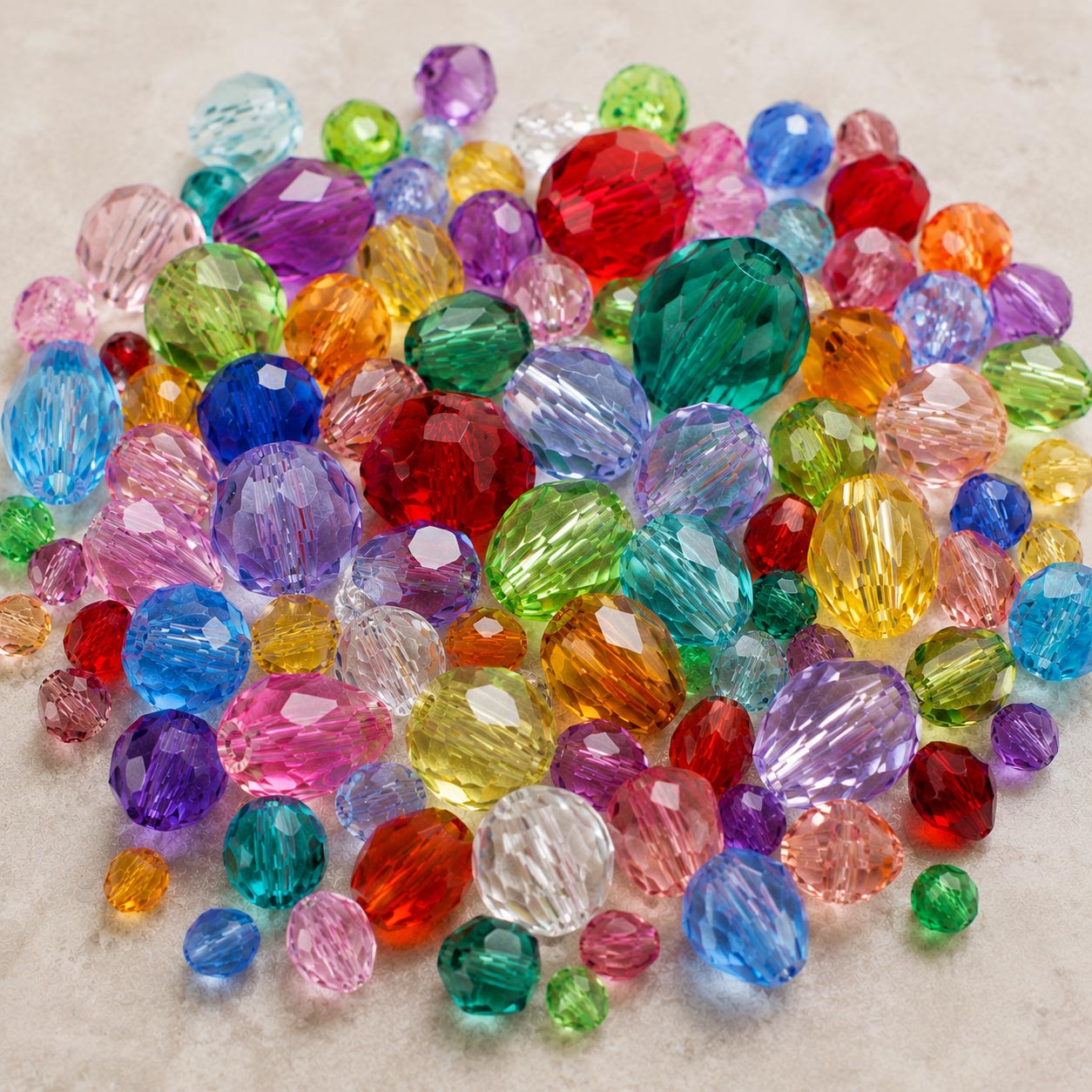
Faceted beads have multiple flat surfaces cut or molded into the bead. These facets reflect light and create sparkle, making faceted beads popular for jewelry, ornaments, suncatchers, holiday decorations, and elegant craft projects. They may be round, oval, bicone, teardrop, or other decorative shapes.
Faceted beads are commonly made from glass, crystal, acrylic, or plastic. Acrylic faceted beads are lightweight and affordable, while glass and crystal versions often provide greater brilliance and weight. Their light-catching quality makes them especially useful in projects meant to shimmer or reflect light.
Information coming soon.
Gemstone beads are made from natural or imitation stones that have been shaped, drilled, and polished for stringing. Common gemstone bead materials include jasper, quartz, agate, amethyst, turquoise, jade, hematite, onyx, and many others.
They are used most often in jewelry, prayer beads, bracelets, necklaces, earrings, and natural-style decorative projects. Because natural stones vary, gemstone beads often show differences in color, pattern, veining, and texture.
Glass beads are made from formed, pressed, molded, or handmade glass. They have been used for centuries in jewelry, trade, decoration, clothing embellishment, and ceremonial objects. Glass beads can be round, faceted, tubular, shaped, pressed, painted, or handmade.
Glass beads are valued for their shine, weight, color depth, and variety of finishes. They may be transparent, opaque, translucent, metallic, iridescent, frosted, or coated. Common uses include jewelry making, embroidery, ornaments, bead weaving, and decorative crafts.
Glitter beads contain reflective particles that catch the light and create a sparkling effect.
Glow-in-the-dark beads come in many different styles of beads. Their unique composition absorbs light and releases a soft glow in darkness after being exposed to sunlight or artificial light.
Information coming soon.
Heishi beads are small, flat, disc-shaped beads that are often strung together in rows. Traditional heishi beads were made from shell or stone, although modern versions may also be made from polymer clay, glass, wood, metal, or plastic.
Heishi beads are commonly used in necklaces, bracelets, earrings, surfer-style jewelry, boho designs, and colorful stacked accessories. Their thin disc shape creates a smooth, layered appearance when strung together.
Information coming soon.
Lampwork beads are handmade glass beads created by melting glass rods with a flame and shaping the molten glass around a metal mandrel. This process allows artists to create colorful patterns, raised decorations, flowers, swirls, dots, and layered effects inside or on the surface of the bead.
Because lampwork beads are handmade, each bead may vary slightly in size, shape, and design. They are commonly used as focal beads in jewelry, pendants, bracelets, ornaments, and collectible beadwork.
Information coming soon.
Frosted or matte beads can be any shape and have a non-glossy surface that diffuses light, creating a softer and more subdued appearance.
Information coming soon.
Metal beads are made primarily from metal or metal alloys. They may be smooth, textured, stamped, carved, cast, plated, or decorated with raised designs. Common finishes include silver-tone, gold-tone, copper, brass, bronze, antique, and oxidized effects.
Metal beads add weight, contrast, shine, and detail to beadwork. They are often used in jewelry, leather crafts, macrame, keychains, decorative accessories, and mixed-material designs. Some metal beads are solid metal, while others may be hollow or plated over another material.
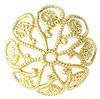
Metal beads are made primarily from metal, such as brass, copper, aluminum, stainless steel, pewter, silver, or gold-tone alloys.
Metallic beads have a shiny finish that resembles polished metal, such as gold, silver, copper, bronze, or chrome.
Information coming soon.
Neon beads have very bright, highly saturated colors that appear vivid and eye-catching.
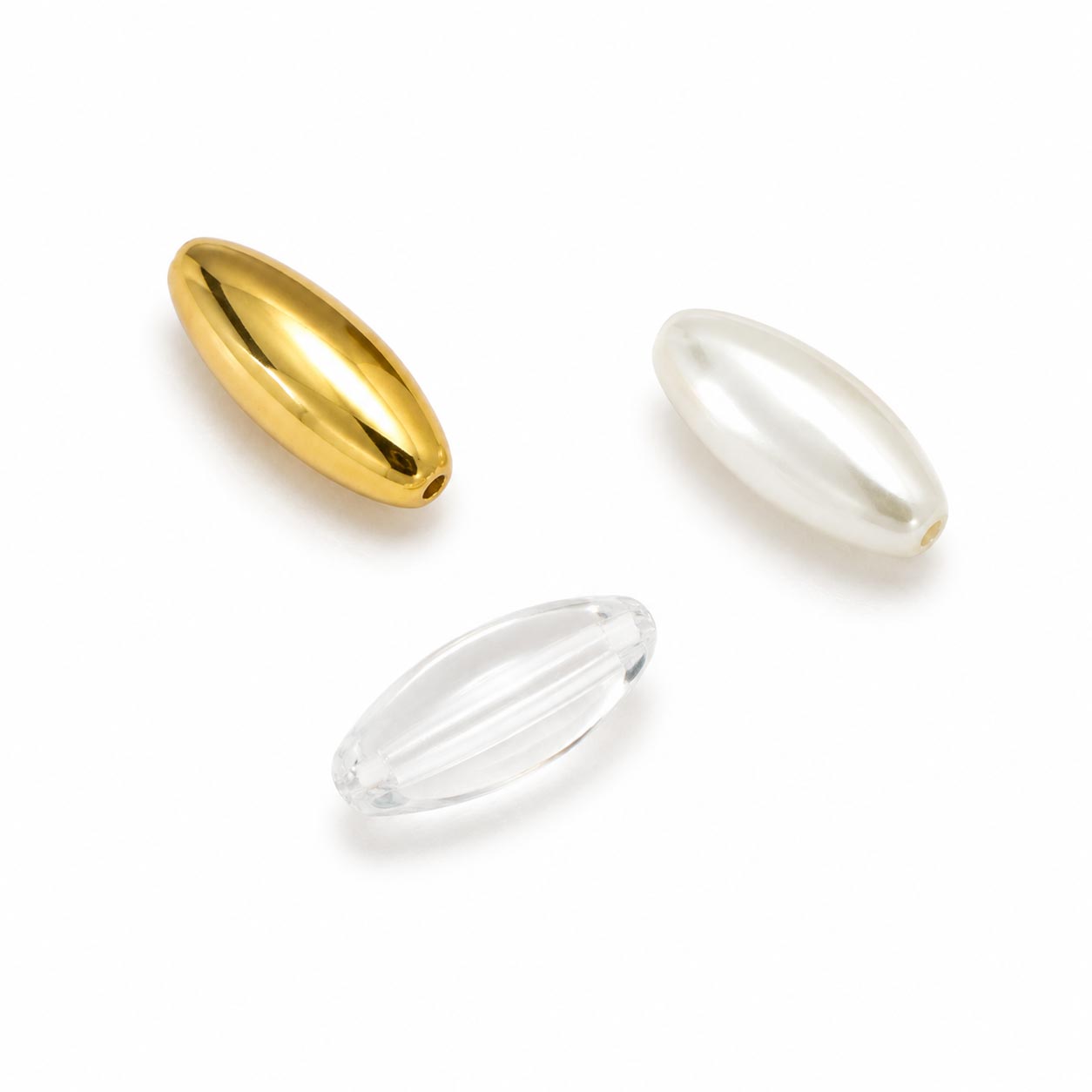
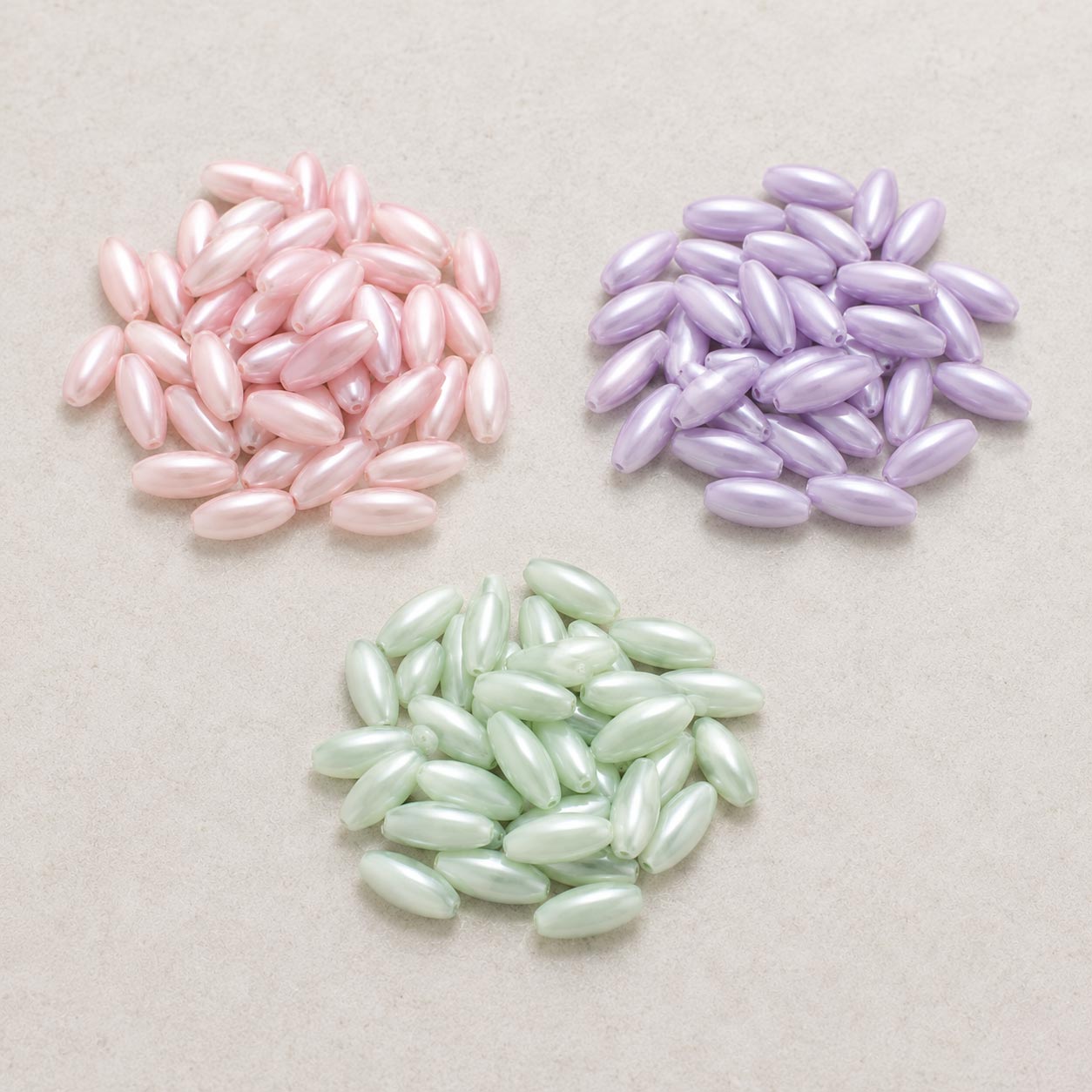
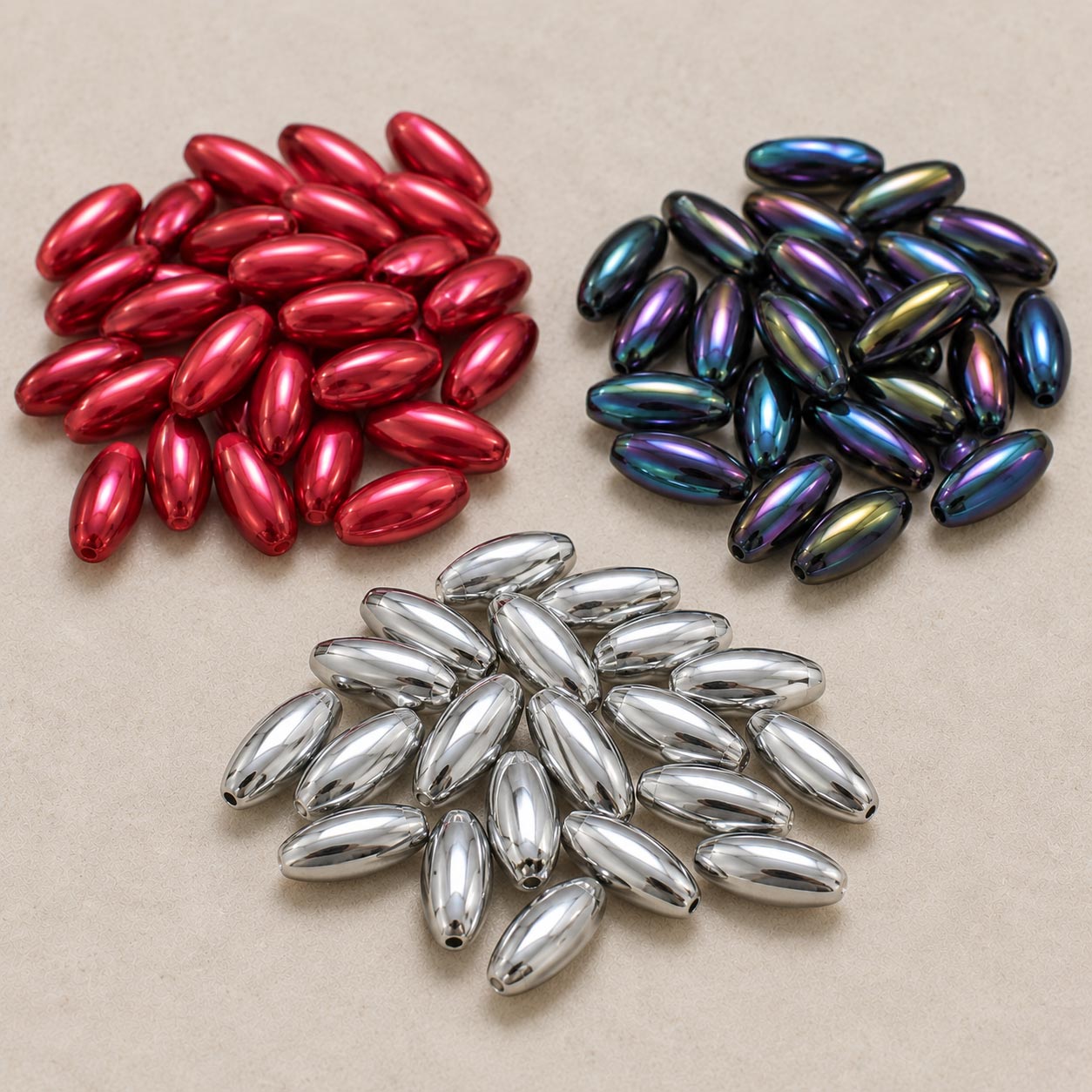
Shape: Oat beads are elongated oval beads with gently tapered, rounded ends that resemble a grain of oats, wheat, or rice. They have a single hole running lengthwise through the center and are designed to create smooth, flowing lines and natural-looking textures in beadwork and providing a unique silhouette that differs from traditional round or faceted beads.
Materials, Sizes, and Finishes: Oat beads are commonly manufactured from pressed glass, although they are also popular made from acrylic and other materials. They are available in a variety of sizes commonly ranging from approximately 4mm to 10 mm in length, and 3 mm to 6 mm in width, depending on the manufacturer and are produced in transparent, translucent, opaque, metallic, matte, frosted, luster, pearlized, iridescent, Picasso, and Aurora Borealis (AB) finishes, along with many specialty color treatments.
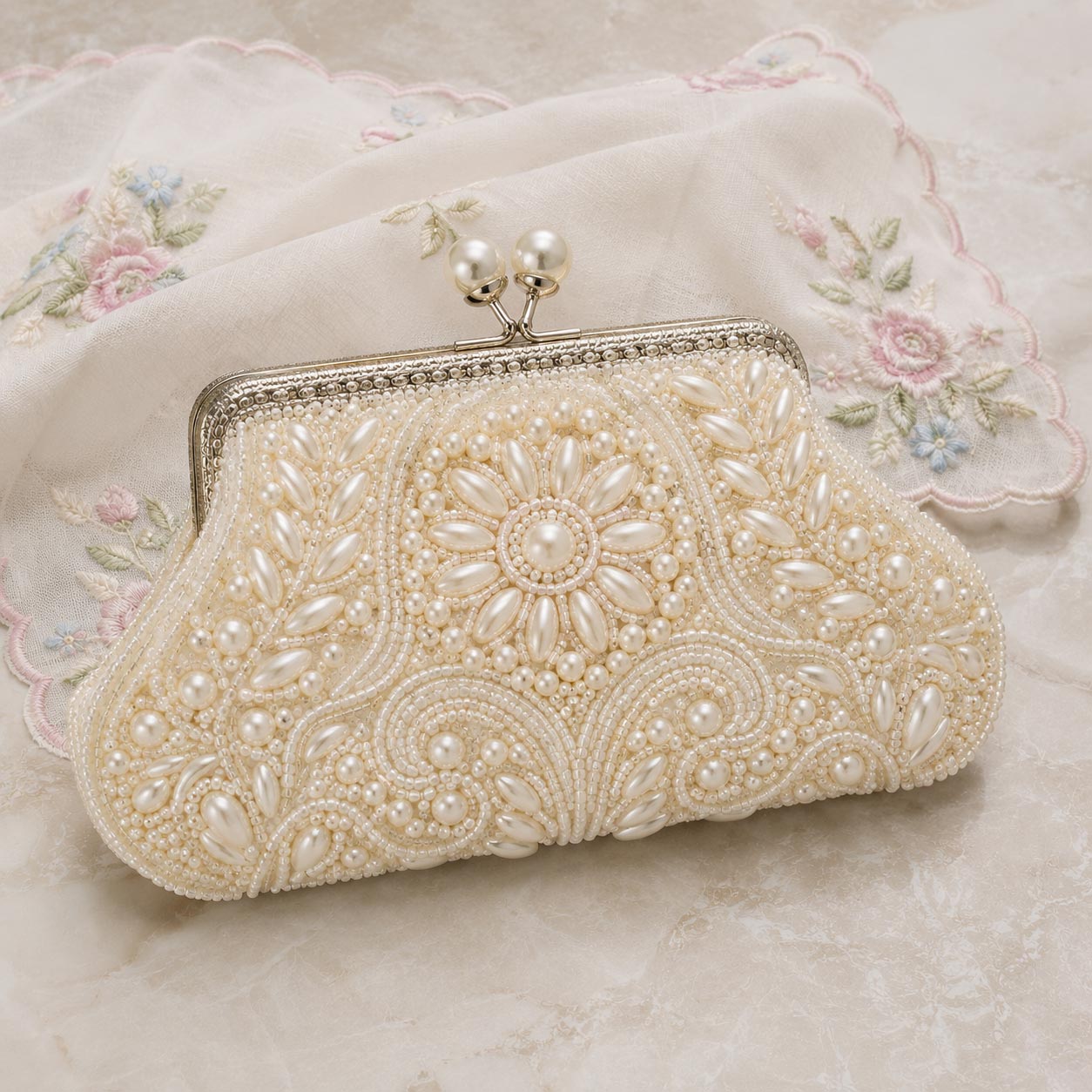
Description and Information: Oat beads are attractive specialty beads prized for their slender, grain-like profile and versatility in jewelry making and bead weaving. Their elongated shape creates a softer, more organic appearance than round beads and allows them to nest together in flowing patterns that resemble leaves, petals, scales, or woven fabric.
Because of their balanced proportions, oat beads work well in necklaces, bracelets, earrings, fringe, bead embroidery, and decorative weaving projects. They combine beautifully with seed beads, crystals, rounds, and other specialty shapes to add texture and movement without overwhelming a design.
Although some suppliers distinguish between oat beads, wheat beads, and rice beads, many manufacturers and retailers use these names interchangeably to describe essentially the same elongated oval bead shape. The terminology often varies by country, manufacturer, or marketing preference rather than by any significant difference in the bead itself.
Fun Facts: The bead's name comes from its resemblance to a grain of oats. Depending on the supplier, the exact same bead may be marketed as an oat bead, wheat bead, or rice bead. This can make shopping confusing for beginners, even though the products are often identical. In bead weaving, rotating oat beads in different directions can create surprisingly varied visual effects, from flower petals to fish scales and braided patterns.
History and Origin: Oat beads emerged as part of the growing family of precision-pressed specialty glass beads developed to expand creative possibilities for jewelry designers and bead artists. Improvements in glass molding technology during the late twentieth and early twenty-first centuries made it possible to manufacture consistent, uniquely shaped beads that complemented traditional seed beads and other popular components. Today, oat beads are produced by several manufacturers and continue to gain popularity among bead weaving enthusiasts.
Information coming soon.
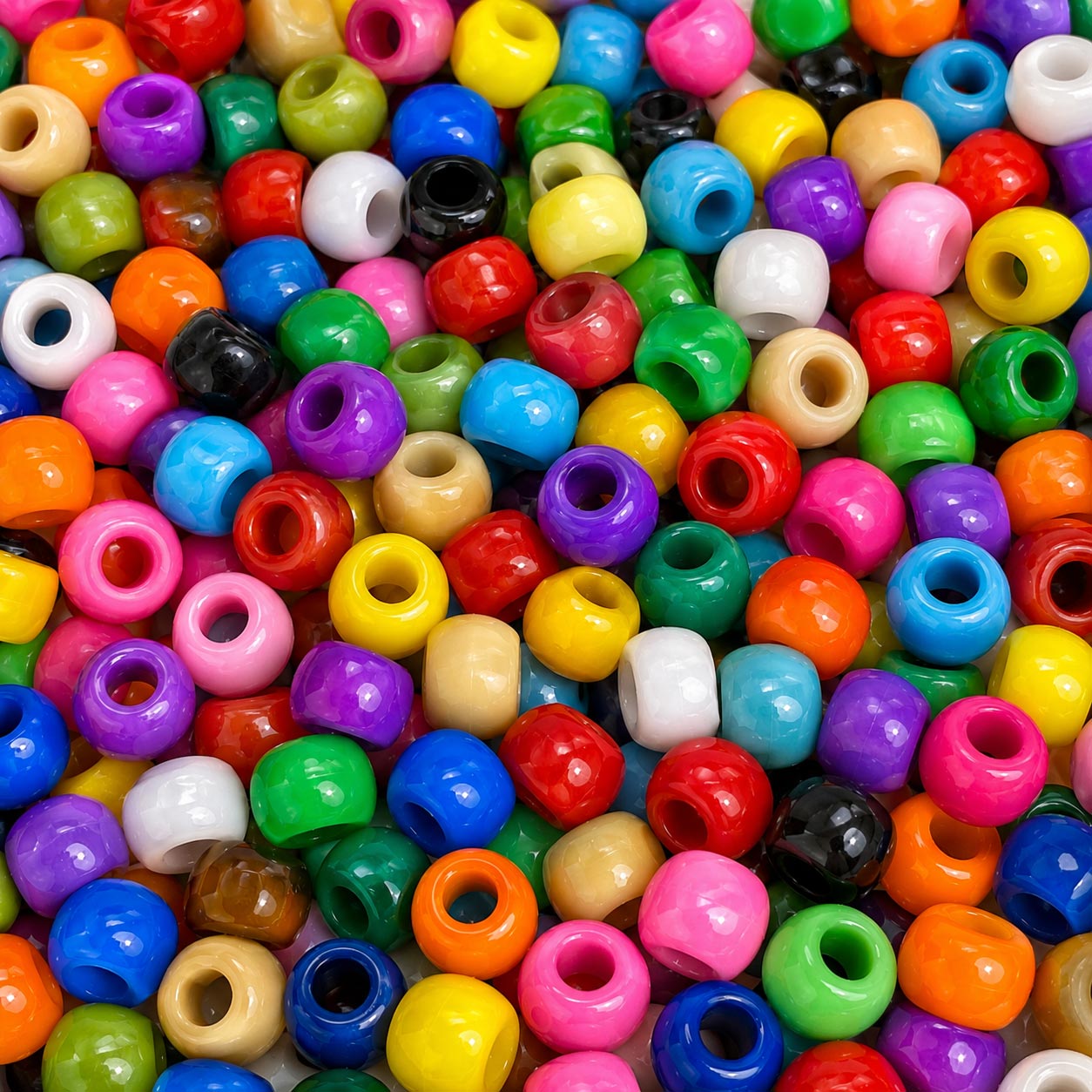
Opaque beads do not allow light to pass through them. They provide solid, bold color and work well when strong contrast is desired.
Pearl beads are beads designed to resemble natural pearls or cultured pearls. They usually have a smooth, rounded surface and a soft, lustrous sheen. Pearl beads may be made from glass, acrylic, plastic, shell, or genuine pearl material.
These beads are often used in wedding crafts, jewelry, floral arrangements, ornaments, doll accessories, and elegant decorations. Imitation pearl beads provide the look of pearls at a lower cost and are available in many sizes, colors, and finishes.
Pearlized beads have a smooth, lustrous coating that resembles a pearl. The finish gives a soft shimmer rather than a bright sparkle.
Information coming soon.
Plated beads are made from one material and coated with a thin layer of another material, often to create a metallic or decorative surface.
Polymer clay beads are made from a moldable clay-like material that hardens when baked. They can be formed into discs, rounds, flowers, fruits, animals, letters, and many novelty shapes. Polymer clay is also used to create colorful patterns, marbled effects, and miniature designs.
These beads are popular for bracelets, earrings, children’s jewelry, themed accessories, holiday crafts, and playful designs. Flat polymer clay disc beads are often used in colorful stretch bracelets and stacked jewelry.
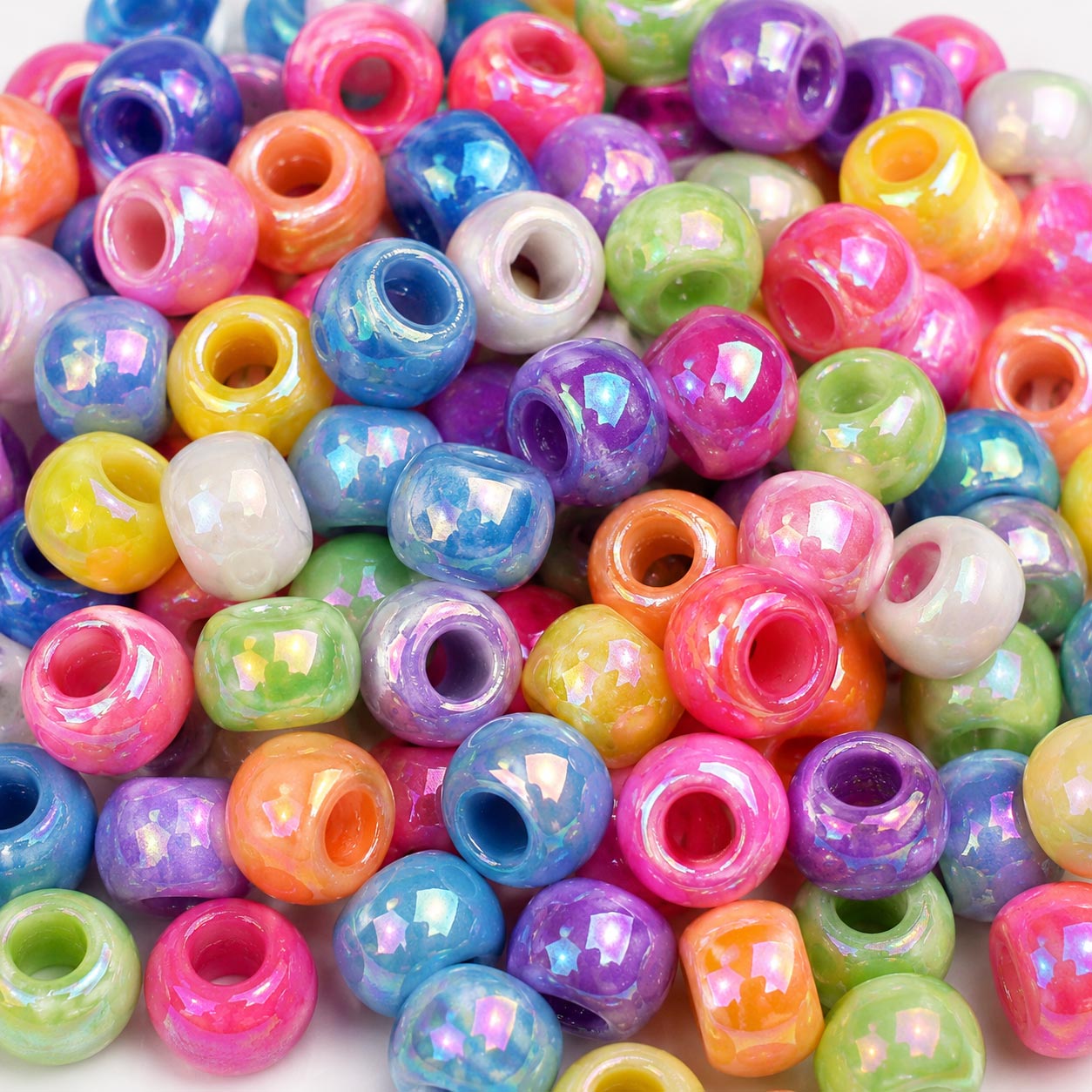
Pony beads are among the most recognizable and widely used craft beads in the world. Their simple shape, large hole, and broad range of colors have made them a favorite choice for crafters of all ages for generations. Whether used in children's crafts, jewelry projects, camp activities, holiday decorations, or decorative beading, pony beads remain one of the most versatile bead types available.
Traditional pony beads feature a rounded barrel shape with a hole running through the center from one flat end to the other. This large opening allows the beads to be easily strung onto a variety of materials including plastic lacing, cord, yarn, ribbon, elastic, and other threading materials. Their easy-to-handle size makes them especially popular with beginners and younger crafters who may find smaller bead types more difficult to work with.
The most common pony bead measures approximately 6mm by 9mm, with a 3mm to 4mm hole, although variations in size can be found depending on the manufacturer and intended use. Pony beads are most often made from plastic or acrylic materials, making them lightweight, durable, and economical. Their durability allows finished projects to withstand regular handling, making them ideal for keychains, backpack charms, zipper pulls, and other frequently used items.
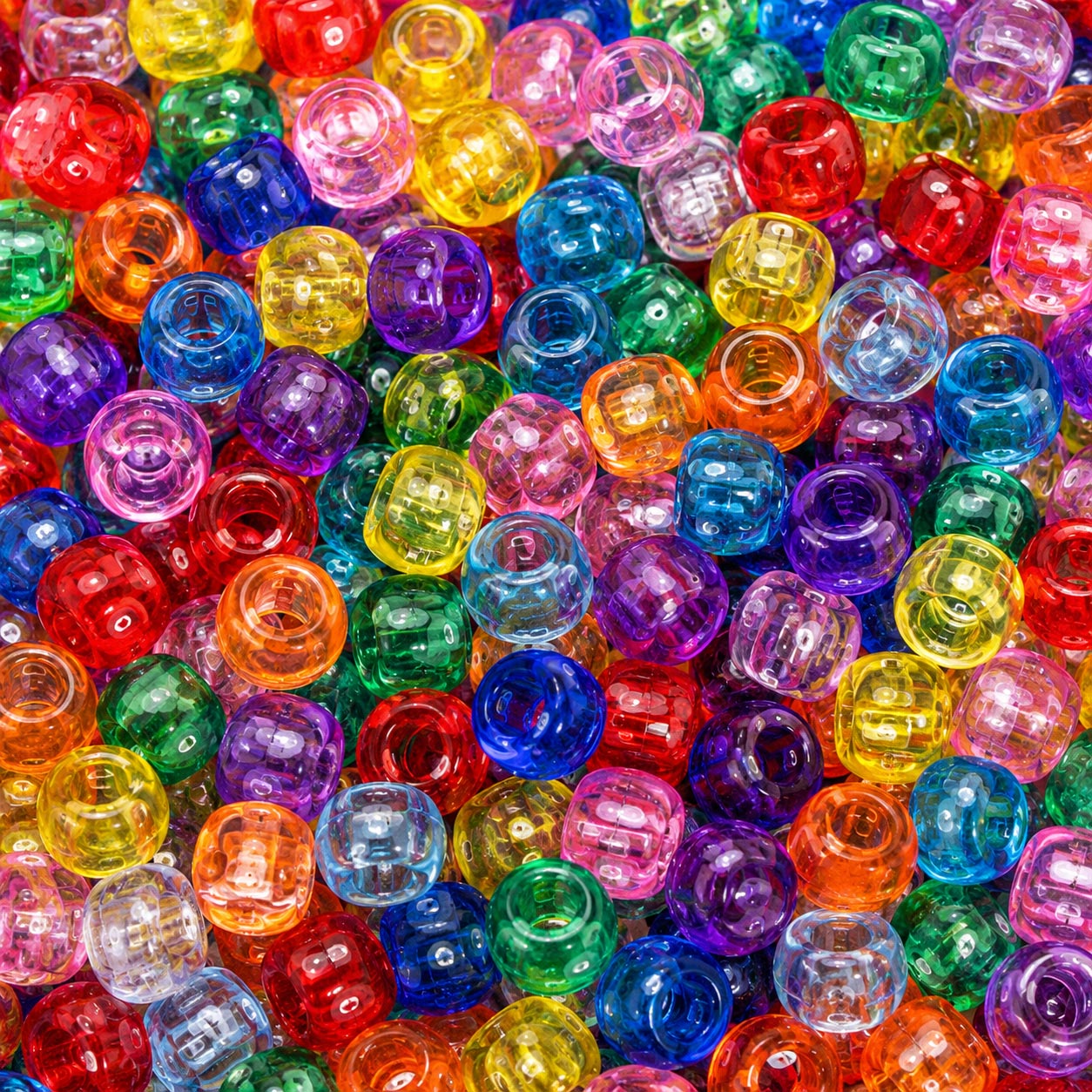
One of the reasons pony beads have remained so popular is the incredible variety of colors and finishes available. They can be found in solid opaque colors, transparent and translucent colors that allow light to pass through, pearlized finishes with a soft luster, metallic finishes that mimic the appearance of metal, glitter finishes that sparkle in the light, and even glow-in-the-dark varieties. This wide selection allows crafters to create everything from bright and playful children's projects to more decorative and sophisticated designs.
Pony beads are used in a wide range of craft projects. They are perhaps best known for beaded animals, friendship jewelry, keychains, and camp crafts, but they are also commonly used in ornaments, holiday decorations, suncatchers, home décor projects, educational activities, and decorative accessories. Their large hole and durable construction make them particularly well suited for projects that require repeated handling or frequent use.
Because pony beads are so common in craft stores and educational settings, they are often one of the first bead types encountered by new crafters. Their affordability and ease of use have helped introduce countless people to the hobby of beading. Many experienced crafters can trace their first beading project back to a simple creation made with colorful pony beads.
Pony beads are sometimes compared to other large-hole craft beads such as crow beads, barrel beads, and various plastic craft beads. While these bead types may share certain similarities, they often differ in shape, size, material, or traditional use. Understanding these differences can help crafters select the bead that best suits their project.
The exact origin of the term "pony bead" is not fully documented, although many historians believe the name may have originated from earlier trade beads that were small enough to be transported by pack animals, including ponies. Over time, the term became associated with a specific style of large-hole bead used in decorative and craft applications. Today, pony beads continue to be one of the most popular bead types for both beginners and experienced crafters, valued for their versatility, colorful appearance, and ease of use.
Information coming soon.
Round beads are one of the most basic and widely used bead shapes. They are spherical or nearly spherical and have a hole running through the center. Their simple shape makes them versatile and easy to combine with almost any other bead type.
Round beads may be made from glass, acrylic, wood, metal, gemstone, ceramic, pearl, or plastic. They are used in jewelry, ornaments, rosaries, keychains, decorative crafts, home décor, and countless beading projects.
Information coming soon.
Seed beads are very small beads commonly used in detailed beadwork, jewelry making, embroidery, loom work, and bead weaving. They are usually round or slightly rounded in shape and have a hole running through the center. Because of their small size, seed beads allow crafters to create detailed patterns, textures, and designs that would not be possible with larger beads.
Seed beads are most often made of glass and are available in many sizes, colors, and finishes. Their sizing system can be confusing at first because larger numbers generally indicate smaller beads. Common sizes include 6/0, 8/0, 10/0, 11/0, and 15/0. Seed beads are popular for jewelry, decorative trim, bead embroidery, ornaments, and traditional beadwork.
Information coming soon.
Shell beads are made from natural shell materials, including mother-of-pearl, cowrie shell, abalone, and other seashells. They may be carved, cut, polished, dyed, or drilled in natural forms.
Shell beads are commonly used in beach-themed jewelry, summer crafts, anklets, necklaces, earrings, home décor, and natural-style projects. They often feature soft luster, organic shapes, and color variations created by the shell itself.
Information coming soon.
Spacer beads are small beads used between larger beads to add separation, rhythm, contrast, or decorative detail. They may be simple and plain or highly decorative. Spacer beads help define patterns and can make a finished design look more polished.
Spacer beads are often made from metal, glass, acrylic, crystal, or gemstone materials. They are common in bracelets, necklaces, earrings, rosaries, keychains, and many jewelry-making projects.
Information coming soon.
Translucent beads isn't a kind of bead but more of a color or style that allows some light to pass through, but they are not completely clear. They create a softer, glowing appearance.
Translucent beads allow some light to pass through, but they are not completely clear. They create a softer, glowing appearance.
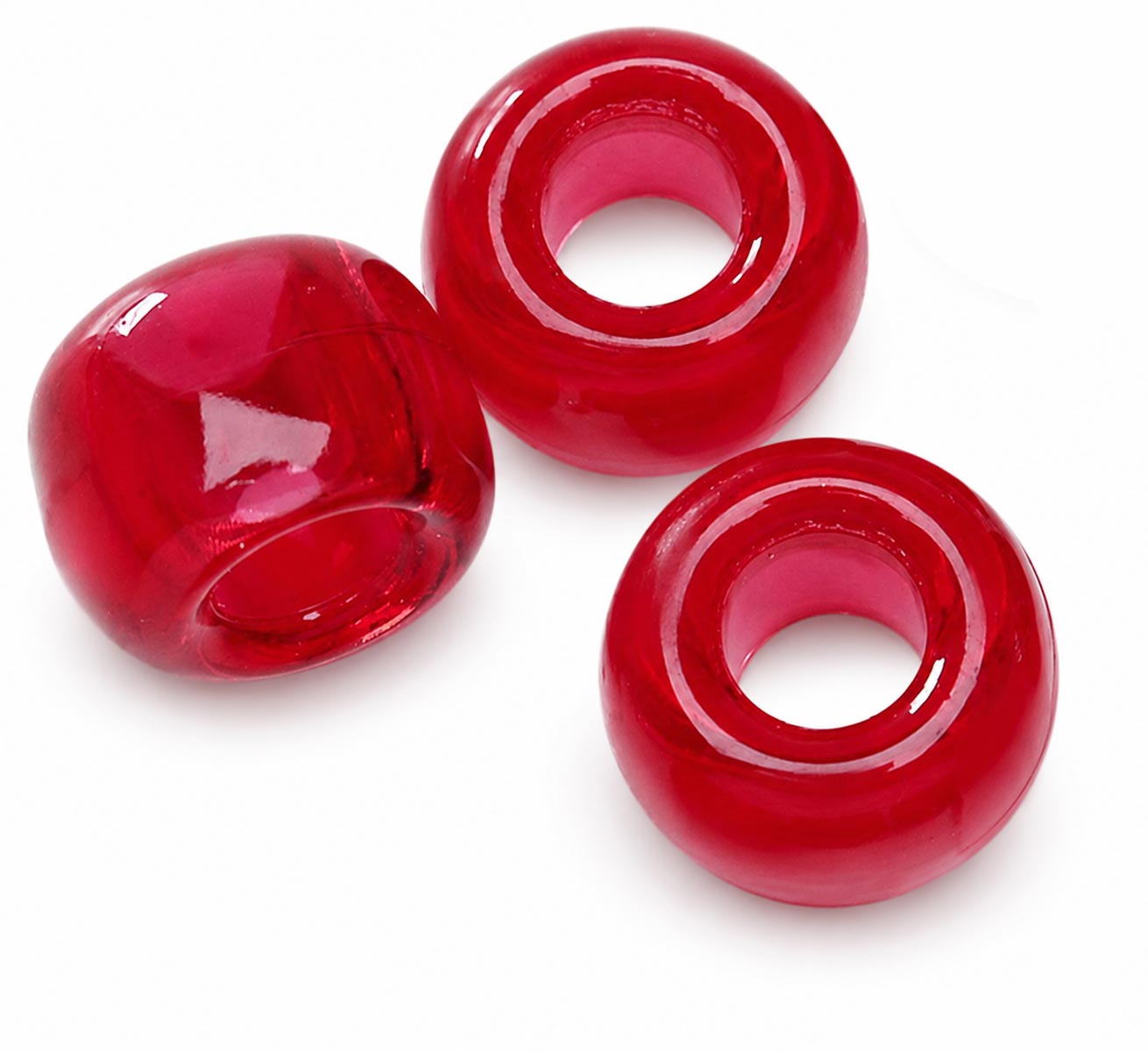
Transparent beads allow light to pass through and appear clear or see-through. They are often used for sparkling, light-catching projects.
Information coming soon.
Wood beads are made from natural or dyed wood and are valued for their lightweight feel, warm appearance, and organic texture. They may be unfinished, polished, painted, stained, carved, printed, or coated.
Wood beads are commonly used in jewelry, macrame, home décor, garlands, ornaments, doll making, farmhouse crafts, and natural-style designs. Their lightweight nature makes them comfortable for larger jewelry pieces and decorative hanging projects.
Home >